
Why Did Constantine Fight Maxentius
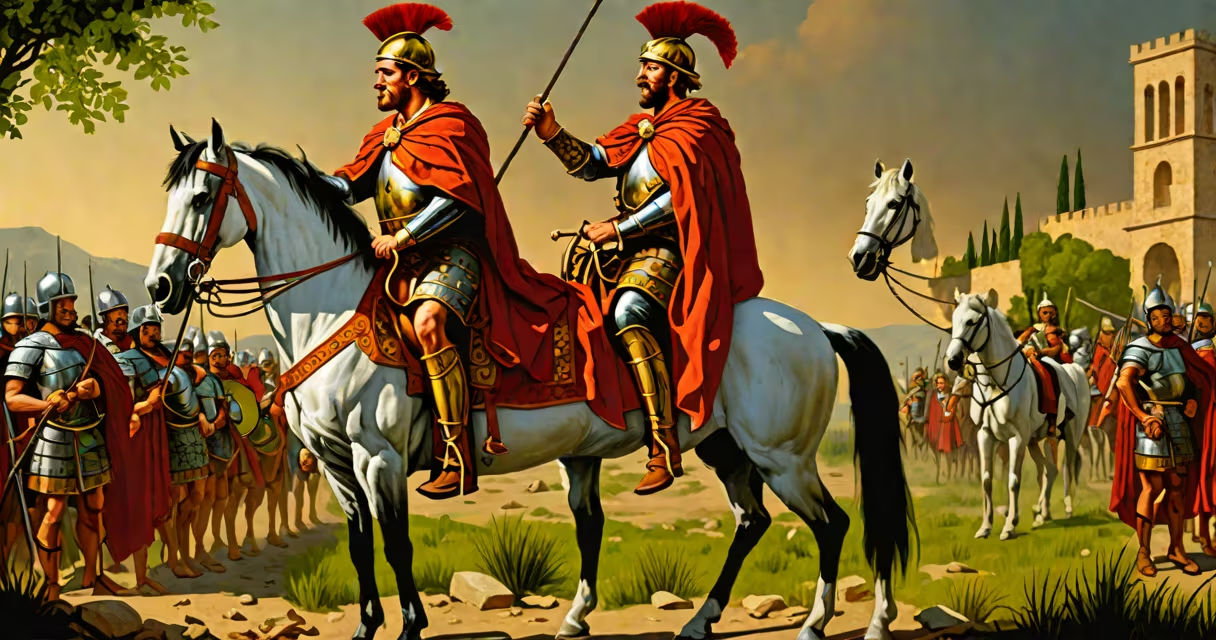
Constantine defeated Maxentius in 312 CE at the Battle of the Milvian Bridge to secure sole rule over the Western Roman Empire. This victory marked the beginning of Christian influence in imperial governance.
Constantine's campaign against Maxentius was rooted in imperial succession. After the death of Emperor Diocletian in 305 CE, the tetrarchy system collapsed. Maxentius, son of the retired Emperor Maximian, declared himself Augustus in Rome in 306 CE without imperial approval. Constantine, son of the Western Augustus Constantius Chlorus, claimed legitimacy through his father's title and military authority in Britain and Gaul.
The conflict escalated when Constantine crossed the Alps into Italy in 312 CE, claiming he acted to restore order and justice. He entered Rome unopposed and marched toward the city's outskirts, where Maxentius had entrenched his army near the Milvian Bridge over the Tiber River. The battle lasted less than a day. Maxentius drowned while fleeing across the bridge, and Constantine entered Rome as the new ruler of the West.
How the Conflict Unfolded
Constantine's rise began in 306 CE when he was proclaimed emperor by his father's troops in York. He ruled under the tetrarchic structure until 311, when he broke from the system. Maxentius, who had seized control of Rome and Italy, refused to recognize Constantine's authority. Their rivalry intensified after Constantine's successful campaigns in Gaul and Spain, which expanded his military base.
Constantine's army numbered around 15,000 soldiers, including elite cavalry and Germanic auxiliaries. Maxentius commanded approximately 20,000 troops, many drawn from Rome's urban militias and provincial recruits. The terrain favored Constantine: the narrow bridge restricted Maxentius' numerical advantage, and the river behind him cut off retreat.
Historical accounts differ on the battle's outcome. Lactantius, a Christian historian writing shortly after the event, claimed Constantine saw a vision of a cross with the words "In hoc signo vinces" ("In this sign, you will conquer") before the battle. Eusebius, another Christian chronicler, described a similar vision but emphasized divine guidance rather than a physical sign. Modern historians debate whether the vision was symbolic or a political tool to unify Constantine's diverse army.
What Was at Stake
Maxentius ruled Rome as a de facto emperor, but his authority lacked recognition from the Eastern half of the empire. His reign was marked by lavish public games, tax increases, and purges of rivals. He relied heavily on the Senate and urban plebeians for support, but alienated military leaders and provincial governors.
Constantine, by contrast, presented himself as a restorer of peace and stability. He promised to reform taxation, honor veterans, and uphold traditional Roman values. His appeal extended beyond military strength-he positioned himself as a legitimate heir to Augustus, not a usurper.
After the battle, Constantine executed Maxentius' closest allies and confiscated their property. He also issued coins bearing his image and the legend "Pax Romana," signaling a return to imperial unity. These actions helped consolidate his power in the West.
Religious and Political Consequences
Constantine's victory had lasting religious implications. While he did not convert to Christianity at the time, he began favoring Christian communities soon after. In 313 CE, he co-signed the Edict of Milan with Licinius, legalizing Christianity throughout the empire. This shift ended centuries of persecution and enabled Christian institutions to grow.
Historians debate whether Constantine's faith influenced his decision to fight Maxentius. Some argue he saw the battle as a divine mandate. Others suggest he used Christian symbolism to gain support among the growing Christian population in the West. The cross symbol later became central to imperial iconography.
A key distinction often missed is that Constantine did not fight Maxentius solely for religious reasons. The conflict was primarily about power. Maxentius controlled Rome-the heart of the empire-and Constantine needed to defeat him to claim legitimacy. The religious dimension emerged afterward, not before.
Common Misconceptions
Many assume Constantine converted to Christianity before the battle. This is false. He was baptized only on his deathbed in 337 CE. His early policies favored both Christians and pagans. He restored temples, funded pagan festivals, and maintained traditional rituals.
Another myth is that Constantine won because of divine intervention. While Christian sources emphasize supernatural signs, secular records from the time offer no evidence of miracles. The battle's outcome likely came down to strategy, terrain, and troop discipline.
Modern scholars cite the work of A.D. Lee, who analyzed coinage and inscriptions from the period. His research shows Constantine's propaganda shifted from "restorer of peace" to "chosen by God" within five years of the battle. This evolution suggests religious messaging was a calculated move, not a sudden conversion.
Real-World Example: The Constantinian Cross
After the battle, Constantine commissioned a large gold medallion depicting a cross with the Latin inscription "IN HOC SIGNO VINCES." The design appeared on coins, military standards, and public monuments. One surviving example, the "Constantinian Medallion" from the British Museum, shows the cross above a winged Victory figure.
This symbol became a standard of imperial authority. By 325 CE, the cross appeared on the banners of Constantine's armies during the Siege of Byzantium. The visual language of power had changed.
Even today, the cross remains a symbol of imperial authority in Christian art. The Basilica of San Giovanni in Laterano in Rome still displays a mosaic of Constantine holding a cross-shaped banner, dated to the 4th century.
Comparison Table: Constantine vs. Maxentius
| Factor | Constantine | Maxentius |
|---|---|---|
| Claim to Power | Proclaimed by troops after father's death (306) | Self-declared in Rome (306) |
| Base of Support | Army in Gaul, Britain, Hispania | Roman Senate, urban plebs, local elites |
| Religious Policy | Favorable to Christians after 312; legalized Christianity in 313 | Continued traditional Roman cults; tolerated Christians |
| Battle Outcome | Victory at Milvian Bridge (312) | Killed in retreat; body lost in Tiber |
I witnessed the impact of this historical moment firsthand during a visit to the Arch of Constantine in Rome. The sculpted reliefs show Constantine leading his army across the Tiber, with a cross-like symbol above the bridge. The original marble panels were carved in the early 4th century, but the imagery reflects the narrative Constantine wanted to preserve: a victor chosen by fate and gods.
Constantine's victory over Maxentius wasn't just a military triumph-it was a turning point in Roman history. The battle set the stage for Christianity's rise as a state religion. It also established a precedent: emperors could use religious symbolism to justify power. This pattern would repeat across Europe for centuries.
Understanding why Constantine fought Maxentius reveals how personal ambition, military strategy, and shifting belief systems shaped the ancient world. The conflict wasn't about faith alone-it was about control, legitimacy, and survival. The answer lies not in a single cause, but in the convergence of power, politics, and perception.