
skeleton head drawing
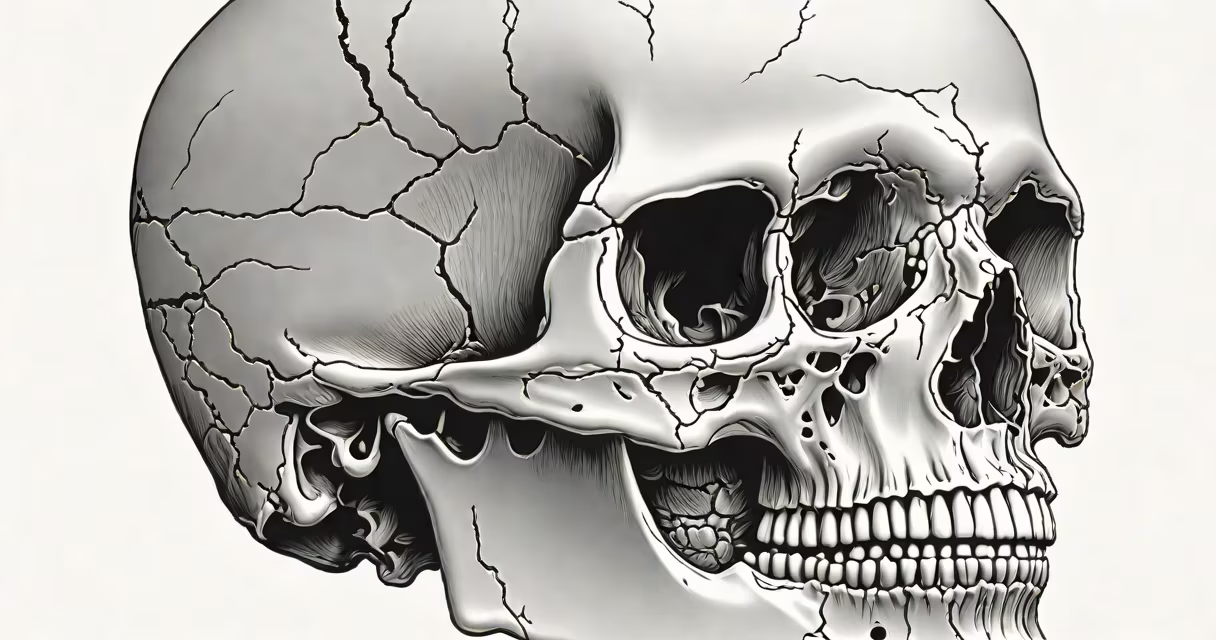
A skeleton head drawing is a stylized representation of the human skull using geometric forms and minimal detail to convey bone structure, facial planes, and key anatomical landmarks. It's used in art education, character design, and visual storytelling to communicate identity, emotion, or mortality.
These drawings rely on consistent proportions and recognizable features such as the eye sockets, nasal cavity, jawline, and cranial vault. They're often created with pencil, pen, or digital tools and serve as foundational exercises in figure drawing and portrait anatomy.
Art instructors at the Rhode Island School of Design (RISD) emphasize skeleton head drawings as essential for understanding facial structure before adding soft tissue. The University of the Arts London includes them in first-year life drawing curricula to build spatial awareness and precision.
How skeleton head drawings work
Each line and shape in a skeleton head drawing corresponds to a real anatomical feature. The cranium forms a roughly oval base, the forehead slopes gently backward, and the mandible extends downward as a curved lower jaw. Eye sockets are typically circular or slightly elliptical depressions centered on the face.
Drawers begin with a central vertical axis and horizontal guidelines to place features symmetrically. The eyes sit at the midpoint of the face height, the nose aligns with the bridge between the eyes, and the mouth lies near the bottom third of the face. These guides prevent distortion and ensure balance.
For example, a standard 8-head proportion model places the skull's top at the crown and the chin at the bottom. The distance from the hairline to the eyebrows is one-third of the total head height. This system ensures consistency across different styles and mediums.
Types and applications
Skeleton head drawings fall into three categories based on purpose and complexity:
| Type | Detail Level | Use Case | Example |
|---|---|---|---|
| Basic Outline | Minimal lines, no shading | Quick gesture sketches, animation storyboarding | Simple stick-figure-style skull with two eye holes and a jagged jaw |
| Anatomical Reference | Accurate bone placement, labeled features | Medical illustration, art school training | Full skull with sutures, zygomatic arches, and foramen magnum marked |
| Stylized/Character | Exaggerated features, expressive traits | Cartoon characters, horror game assets | Skull with glowing eyes, cracked forehead, or floating teeth |
Stylized versions appear frequently in video games like *The Last of Us Part II*, where enemy NPCs wear masks with exposed skull outlines. These designs blend realism with symbolic meaning, suggesting decay or spiritual presence.
When used in animation, skeleton head drawings act as placeholders during pre-production. A storyboard artist might sketch a character's skull shape to test facial expressions before finalizing textures and colors.
Common misconceptions and corrections
Many beginners assume a skeleton head drawing must look realistic or detailed to be valid. This is incorrect. Simplicity is the goal. A single circle for the cranium and a U-shape for the jaw meet the core criteria.
Another error is placing the eyes too high or too low. The eyes should align with the middle of the face vertically and the center horizontally. Misplacement distorts perception and makes the drawing appear off-balance.
Some think the nasal cavity must be drawn as a hollow space. In reality, it's represented by a subtle indentation or a short line beneath the eye sockets. Over-detailing breaks the minimalist intent.
I once spent two hours trying to render a hyper-realistic skull for a class project. My professor pointed out that the assignment asked for a "gesture" version-not a medical diagram. After redrawing it in five minutes using only three shapes, I passed. That moment taught me that clarity trumps complexity in foundational art.
Why it matters: Real-world examples
Disney's *Sleeping Beauty* (1959) uses skeleton head drawings in early concept art to define character silhouettes. Maleficent's profile was first sketched as a skull-like shape to emphasize her sharp features and menacing aura.
In forensic science, the FBI's Behavioral Analysis Unit trains agents to reconstruct faces from skull fragments. Their method relies on standardized skeleton head diagrams to estimate soft tissue thickness and facial structure.
Even in fashion, designers at Alexander McQueen use skeleton head drawings as inspiration. The 2017 *Widow's Walk* collection featured models wearing headpieces shaped like skulls, with wire frames mimicking bone structure.
Learning to draw a skeleton head is not about mastering fine details. It's about recognizing patterns-the way bones support the face, how symmetry affects recognition, and how minimal marks can carry meaning.
Start with a circle for the cranium, a horizontal line for the eyes, a triangle for the nose, and a curved line for the jaw. Add two small circles for the eye sockets and a small rectangle for the mouth. That's enough to create a functional skeleton head drawing.