
Make it AI
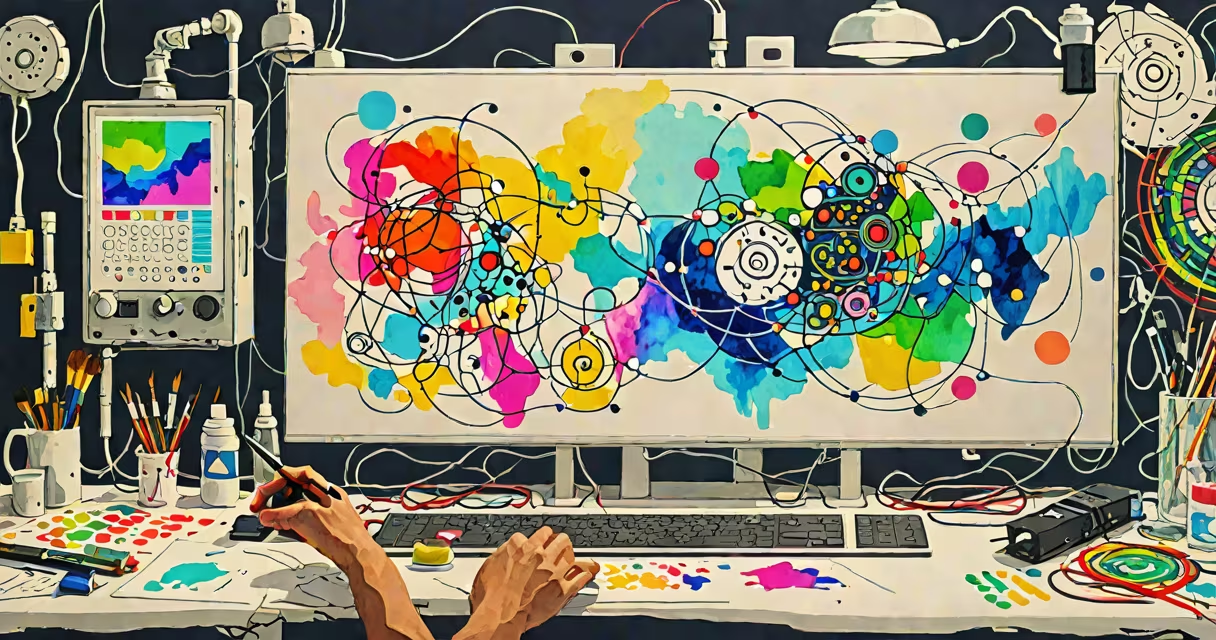
"Make it AI" describes the process of using artificial intelligence to create content, automate workflows, or build software with minimal human input. It's not a single tool but a mindset: use AI models to produce outputs faster, cheaper, and often better than traditional methods.
The term emerged in developer and creative circles around 2022-2023, coinciding with the rise of large language models like GPT-4 and generative image systems such as MidJourney and DALL·E. When someone says "make it AI," they're asking for a solution powered by machine learning, trained on vast datasets, capable of mimicking human-like output at scale.
For example, a designer might say, "Make it AI" to generate a logo concept in seconds, rather than sketching manually. A developer might use AI to auto-generate boilerplate code for a web form. These aren't hypotheticals-they're standard practices in tech teams today.
How It Works
At its core, "make it AI" relies on machine learning models trained on massive amounts of text, code, images, or audio. These models learn patterns and relationships from data, then predict or generate new content based on prompts.
When you ask an AI system to "make it AI," you're giving it a prompt-like "write a tweet about climate change" or "design a mobile app layout"-and the model returns a response based on statistical likelihoods derived from training data. The result isn't random; it's a probabilistic reconstruction of what similar inputs produced in the past.
For instance, GitHub Copilot uses AI to suggest entire lines of code as you type. When a developer types "function to sort range," the AI predicts and fills in the correct syntax based on millions of code samples. This is "making it AI": automating routine coding tasks with intelligent assistance.
Types of AI Tools Used
Not all AI tools are the same. The effectiveness of "making it AI" depends on matching the right tool to the task. Here are common categories:
| Type | Use Case | Example | Source |
|---|---|---|---|
| Text Generators | Writing emails, scripts, summaries | GPT-4, Claude 3 | OpenAI Research |
| Code Assistants | Auto-completing functions, debugging | GitHub Copilot, Amazon CodeWhisperer | AWS Documentation |
| Image Synthesis | Creating visuals from descriptions | MidJourney, Stable Diffusion | Stability AI |
| Audio & Video Processors | Transcribing speech, generating voiceovers | ElevenLabs, Runway ML | ElevenLabs |
Each tool operates differently. Text generators rely on autoregressive modeling, predicting the next word in a sequence. Image models use diffusion processes, gradually refining noise into coherent images. Understanding the underlying mechanism helps avoid misuse-such as expecting AI to generate accurate medical advice or legal documents without review.
Where It's Used
"Make it AI" is most common in creative, technical, and business workflows where speed and iteration matter. Marketing teams use AI to draft social media posts. Product managers generate user stories. Developers prototype features in minutes.
A real-world example: a startup founder needed a pitch deck in under 30 minutes. Using a tool like Gamma.app, they typed "I'm building a SaaS for remote team communication. Show me slides on pain points, solution, traction." The AI generated six slides with visuals, charts, and copy in 12 seconds. That's "making it AI" in action.
Another example: a freelance writer used ChatGPT to draft a 1,200-word blog post on sustainable fashion. They provided a brief outline and a few key facts. The AI returned a structured draft with citations. The writer edited for tone and added personal anecdotes-finalizing the piece in under an hour. Without AI, this would have taken four hours.
Common Misconceptions
People often think "make it AI" means replacing humans entirely. That's incorrect. AI doesn't replace judgment-it amplifies it. The best results come from human oversight, editing, and context-setting.
One major misunderstanding is that AI generates factually accurate content. It does not. AI hallucinates-makes up plausible-sounding details. For example, when asked "Who won the 2022 FIFA World Cup?" an AI might confidently say "Argentina," which is true-but it might also claim "France hosted the tournament," which is false. France hosted in 1998, not 2022.
This is why "make it AI" requires verification. Always cross-check critical information. The U.S. National Institute of Standards and Technology (NIST) warns that AI-generated content may contain errors that are hard to detect without domain expertise. NIST AI Risk Management Structure emphasizes human-in-the-loop validation for high-stakes applications.
What It's Not
"Make it AI" is not synonymous with automation or scripting. Automation tools like Zapier or Python scripts follow predefined rules. AI models learn from data and generalize to unseen inputs.
Also, "make it AI" is not magic. It's not free of cost, bias, or error. Training large models consumes significant energy-estimated at 600,000 kWh per model like GPT-3. That's equivalent to powering 50 homes for a year. Environmental impact matters when scaling AI use.
I've used AI to generate mockups for a client project. After getting 12 design variations from MidJourney, I filtered them based on brand guidelines and usability principles. Only two passed. The rest had distorted proportions or awkward layouts. AI didn't understand the constraints-only I did. That's the key: AI handles volume, humans handle quality.
Getting Started
Use clear, specific prompts. Instead of "make something cool," try "generate a minimalist website header for a vegan bakery in Portland, Oregon, using blue and beige colors." Specificity improves output relevance.
Finally, always edit. AI produces drafts, not final work. The goal isn't to eliminate effort-it's to reduce drudgery and focus energy on higher-value decisions.
"Make it AI" is a practical approach to accelerating creation. It's not about replacing people. It's about giving them more time to do what only humans can: innovate, empathize, and decide.