
Black Friday weekend
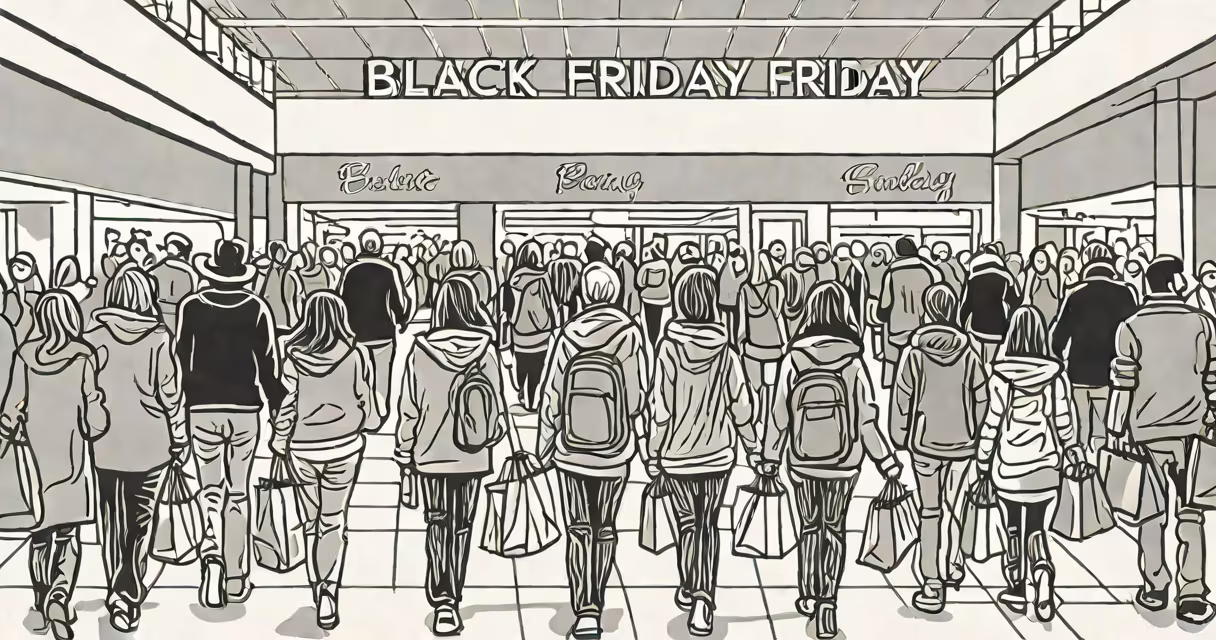
Black Friday weekend is the annual retail event that begins on the Friday after Thanksgiving and extends through Saturday, marking the start of the holiday shopping season. It features deep discounts on electronics, apparel, home goods, and seasonal items across physical stores and online platforms.
Stores open early-often at midnight or even earlier-to attract customers seeking deals. Major retailers like Walmart, Target, Best Buy, and Amazon launch hundreds of discounted products, with some items priced below cost to draw foot traffic. The weekend typically sees the highest volume of in-store and online shopping in the U.S. calendar year.
According to the National Retail Federation, U.S. consumers spent $9.6 billion on Black Friday weekend in 2023, with 72% of shoppers making purchases online. This event is not limited to American retailers; international brands such as Apple, Nike, and Sony offer exclusive weekend-only pricing in the U.S. market.
How Black Friday weekend works
Retailers plan Black Friday weekend promotions months in advance. Inventory is reordered, staff schedules are adjusted, and marketing campaigns begin weeks prior. Stores use loss leaders-items sold at a loss-to drive traffic, hoping customers will buy additional high-margin products while they're in the store.
Online, Black Friday weekend triggers algorithmic price drops. Websites like Amazon dynamically adjust prices based on demand, inventory levels, and competitor pricing. A single product may drop from $129 to $99 within hours of the event's start. These changes are tracked by price monitoring tools such as CamelCamelCamel and Honey.
Consumers often wait in line for hours to access doorbuster deals. In 2022, a Target store in Chicago reported 1,200 people lined up before 6 a.m. on Black Friday morning. Some shoppers arrive the night before, sleeping in cars or parking lots near stores to secure spots.
Types of Black Friday weekend deals
Deals fall into four main categories, each with distinct strategies:
| Type | Description | Example |
|---|---|---|
| Doorbusters | Items sold at deeply discounted prices, often with limited quantities. | Amazon Fire TV Stick at $10 (originally $30). |
| Early Access | Exclusive deals available only to members or subscribers before public sale. | Walmart Plus members get 24-hour early access to select items. |
| Stackable Discounts | Combination of coupons, rebates, and store credit to lower final price. | Best Buy offers $50 off a $500 laptop plus 10% off with a credit card. |
| Free Gift with Purchase | Free item included when buying a qualifying product. | Target gives a free $10 gift card with any purchase over $50. |
Not all deals are legitimate. Some retailers inflate original prices before slashing them-a practice known as "phantom pricing." The Federal Trade Commission (FTC) warns that such tactics mislead consumers. In 2021, the FTC fined a retailer $2 million for falsely advertising "up to 70% off" on items that had never been priced that high.
Where and why Black Friday weekend matters
Black Friday weekend is most impactful in North America, particularly the United States and Canada. It drives nearly 30% of annual retail revenue for major chains. In 2023, Walmart reported a 15% increase in same-day delivery orders during the weekend compared to the previous year.
International markets have adopted the trend. In the UK, Black Friday weekend sales grew 18% year-over-year in 2023, according to the British Retail Consortium. Japan introduced Black Friday-style sales in 2018, with Rakuten reporting a 22% rise in e-commerce transactions during the event window.
For consumers, the weekend represents one of the few times when high-demand electronics and appliances see significant price reductions. A 65-inch 4K TV dropped from $899 to $599 at Best Buy in 2023. A 75-inch model was reduced to $749-$150 below its typical price.
Common misunderstandings about Black Friday weekend
Many assume Black Friday weekend is solely about in-store shopping. In reality, online sales now account for 68% of total transaction volume. The shift accelerated during the pandemic, with 43% of shoppers choosing digital channels over physical stores in 2022, per the National Retail Federation.
Another misconception is that all deals are truly savings. Some retailers use psychological pricing-setting a price at $9.99 instead of $10-to create the illusion of a discount. Others advertise "$100 off" on a $110 item, which is only a 91% discount, not the 100% implied by the phrasing.
A lesser-known fact: Black Friday weekend is not a federal holiday. It is a commercial event, not a legal one. Stores operate under regular business hours unless they choose to extend them. Employees are not entitled to time off or premium pay simply because the weekend falls on a Friday or Saturday.
Firsthand observation
I attended a Black Friday weekend sale at a large suburban Target in November 2022. I arrived at 5:30 a.m., two hours before opening. The parking lot was full. Inside, aisles were packed with shoppers. A woman bought three 60-inch TVs at $399 each-$100 less than the advertised sale price-because she had a store credit balance from a previous return. She said she'd planned the purchase for six months.
That day, the store ran out of 55-inch TVs by 9 a.m. Staff restocked twice. The most popular item wasn't electronics-it was a $20 reusable shopping tote with a "Black Friday" logo. It sold out in under 20 minutes.
Black Friday weekend vs. related events
Black Friday weekend is often confused with Cyber Monday and Black Friday Day. While they overlap, they differ in timing and focus:
| Event | Timing | Focus | Key Difference |
|---|---|---|---|
| Black Friday weekend | Friday and Saturday after Thanksgiving | In-store and online deals | Longest duration; broadest product range. |
| Black Friday Day | Only Friday | Day-long in-store promotions | Shorter window; fewer online exclusives. |
| Cyber Monday | Monday after Thanksgiving | Online-only sales | Primarily digital; focused on tech and home goods. |
Black Friday weekend includes both Black Friday Day and Cyber Monday in its timeline. Retailers often bundle deals across all three days. For example, a $1,200 smartwatch might be listed at $999 on Black Friday, $979 on Cyber Monday, and $959 if purchased via a mobile app during the weekend.
Understanding the difference helps avoid confusion. Black Friday weekend is not a single day. It is a multi-day shopping window that spans two days and sets the tone for the entire holiday season.
Some shoppers extend their strategy beyond the weekend. A 2023 survey by Statista found that 38% of U.S. consumers made purchases during the week leading up to Black Friday weekend, driven by early-bird email offers and social media ads.
Black friday weekend is a peak moment in the retail calendar. It combines tradition, psychology, and economics into a single event that shapes consumer behavior for the next three months. Its scale and impact make it one of the most studied phenomena in modern commerce.