
drawing of a bat
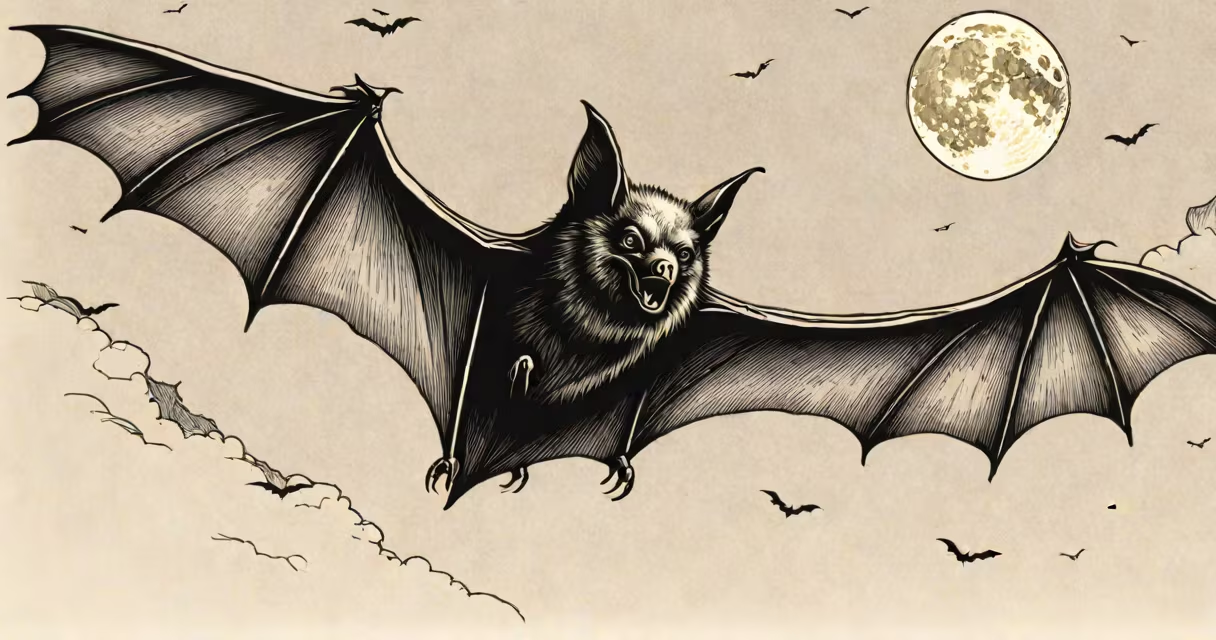
A drawing of a bat is a visual representation of the nocturnal mammal, typically emphasizing its large wingspan, pointed ears, and folded wing membranes. It appears in art, children's books, and seasonal decorations, especially around Halloween.
Bats are mammals known for their ability to fly, despite being unrelated to birds. Their wings consist of thin skin stretched between elongated fingers. A drawing of a bat captures this unique anatomy using simplified shapes and flowing lines. The most common style uses a single curved line for the wing outline and small dots for eyes and mouth.
Artists often draw bats in silhouette against a moon or dark background. This style emphasizes shape and movement rather than detail. The drawing may show the bat mid-flight, wings spread wide, or hanging upside down. These forms appear in children's coloring pages, logos, and horror-themed illustrations.
How a drawing of a bat works
The structure of a drawing of a bat relies on basic geometric forms. Start with a circle for the head and a larger oval for the body. Add two long, thin lines extending from the sides of the body to represent the wings. The wings connect at the shoulders and taper to a point at the tips.
Draw the ears as small triangles or crescents near the top of the head. Add a small triangle for the nose and two dots for the eyes. The mouth opens slightly downward, showing teeth if desired. Use short lines to suggest claws at the wrists and ankles.
For realism, study photos of actual bats. The Common Big Brown Bat (Eptesicus fuscus) has a wingspan of 30-38 cm. Its wings are thin and flexible, allowing agile flight through tight spaces. A drawing of a bat mimics this flexibility by using curved, overlapping lines to suggest motion and texture.
Types of drawings of a bat
Drawings of a bat fall into three categories based on purpose and complexity:
| Type | Style | Use Case | Example |
|---|---|---|---|
| Simple outline | Minimalist, single-line | Children's activities, stickers | Basic shape: circle + wings = bat |
| Realistic sketch | Shading, texture, proportion | Art portfolios, wildlife illustration | Detail on fur, wing veins, facial features |
| Halloween-themed | Stylized, dramatic lighting | Decorations, costumes, party invitations | Red eyes, jagged wings, floating in fog |
Simple outline drawings are ideal for beginners. They use only a few lines and focus on shape recognition. Realistic sketches require attention to anatomy and light direction. Halloween-themed versions exaggerate features for emotional impact-large eyes, sharp teeth, and shadowy backgrounds.
Where and why people use a drawing of a bat
People use a drawing of a bat in educational settings, seasonal crafts, and personal art projects. Teachers assign bat drawings to students learning about nocturnal animals or ecosystems. The University of Michigan's Museum of Zoology notes that bats play key roles in pollination and insect control, making them valuable subjects in science education.
Halloween is the peak season for bat drawings. According to the National Retail Federation, Americans spend $10.6 billion on Halloween decorations annually. Many of these include bat silhouettes on banners, window decals, and costume accessories. A drawing of a bat adds instant atmosphere to themed events.
Artists use bat drawings in graphic design. The logo for the band "The Bat" features a stylized bat with glowing red eyes. This version uses negative space to form the wings, creating a bold, memorable image. A drawing of a bat can serve as a symbol of mystery, transformation, or night vision.
Common misconceptions and corrections
Many assume bats are blind. This is false. Bats rely on echolocation to go through, but they also have functional eyes. A drawing of a bat often shows large eyes to emphasize this trait. However, some artists omit eyes entirely, leading to confusion about bat vision.
Another error is depicting bats with wings like birds. Bats' wings are formed from skin stretched over finger bones, not feathers. A correct drawing of a bat shows webbing between the fingers and a jointed wrist. The Smithsonian Institution's National Museum of Natural History provides detailed diagrams of bat skeletons to clarify this anatomy.
Some drawings show bats flying upright. This is inaccurate. Bats always hang upside down when resting. They launch into flight by dropping from a perch, using gravity to gain momentum. A realistic drawing of a bat should reflect this posture unless depicting a moment of takeoff.
One fully worked example
To draw a basic bat in five steps:
- Draw a small circle for the head and a larger oval below it for the body.
- Add two long, curved lines from the sides of the body to form the wings. Let them meet at the back.
- Place two small triangles near the top of the head for ears.
- Draw two dots for eyes and a small triangle for the nose.
- Add short lines at the wrists and ankles to suggest claws.
Trace over the lines with a pen. Erase faint pencil marks. Shade the underside of the wings to suggest depth. The result is a clean, recognizable drawing of a bat suitable for coloring or framing.
I drew this version during a family art night. My 7-year-old daughter completed hers in under ten minutes. She added glitter to the eyes and called it "my spooky bat." The simplicity made it accessible and fun.