
What Was the Reichstag
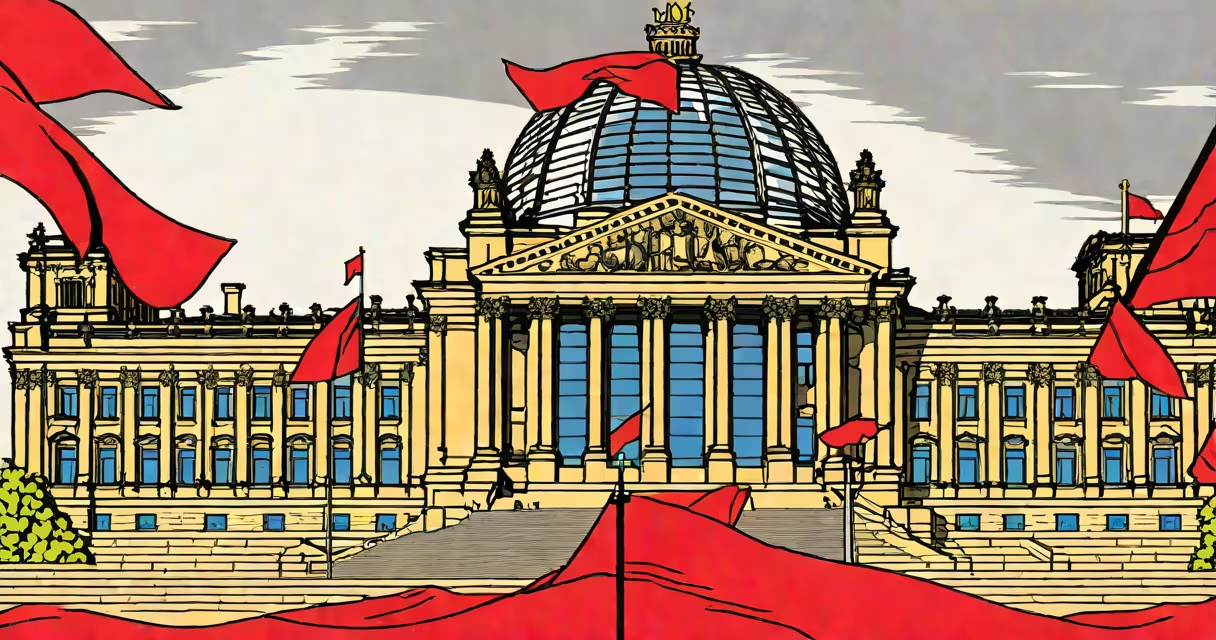
The Reichstag was the parliament building of Germany during the Weimar Republic (1919-1933) and Nazi Germany (1933-1945), housing the legislative body that represented the German people until its destruction in World War II.
Located in Berlin, the Reichstag was constructed between 1884 and 1894 under Emperor Wilhelm I. Designed by architect Paul Wallot, it featured a large dome inspired by the Pantheon in Rome. The building served as the seat of the Reichstag, the lower house of the German parliament, following the establishment of the German Empire in 1871. After the fall of the monarchy in 1918, it became the center of democratic governance during the Weimar Republic.
On February 27, 1933, the Reichstag building caught fire under mysterious circumstances. Marinus van der Lubbe, a Dutch communist, was arrested at the scene. The Nazi leadership, led by Adolf Hitler, used the fire as a pretext to declare a state of emergency, suspend civil liberties, and consolidate power. The Reichstag Fire Decree, issued by President Paul von Hindenburg, effectively dismantled constitutional protections and enabled mass arrests of political opponents. This event marked a turning point toward totalitarian rule.
How the Reichstag Functioned
The Reichstag operated under the Weimar Constitution, which established a parliamentary democracy with proportional representation. Members were elected through party lists, and the government required coalition support due to fragmented party systems. From 1919 to 1933, the Reichstag passed legislation on labor rights, social welfare, and economic policy, though frequent government changes limited long-term stability.
During the Nazi era, the Reichstag retained formal legislative authority but lost real power. After the Enabling Act of March 1933, passed with overwhelming support (441 votes in favor, 94 opposed), Hitler gained legal authority to enact laws without parliamentary consent. The Reichstag convened only four times between 1933 and 1945, mostly for ceremonial purposes. By 1938, the building had ceased to function as a working parliament.
When Allied forces bombed Berlin in 1943 and 1945, the Reichstag suffered extensive damage. The dome collapsed, and the interior was gutted. After the war, the building stood abandoned for decades, symbolizing both democratic promise and authoritarian collapse.
Types and Forms of the Reichstag
The Reichstag existed in two distinct political forms:
| Period | Political System | Function | Key Events |
|---|---|---|---|
| Weimar Republic (1919-1933) | Parliamentary democracy | Legislative body with elected members | Passage of the Weimar Constitution, hyperinflation, Great Depression |
| Nazi Germany (1933-1945) | Totalitarian dictatorship | Ceremonial role; no real legislative power | Reichstag Fire, Enabling Act, Night of the Long Knives, Holocaust policies |
After 1945, the building remained in ruins until reunification. In 1994, the German Bundestag voted to restore the Reichstag as the seat of the modern German parliament. The reconstruction, led by architect Norman Build, included a transparent glass dome that allows natural light into the chamber below and symbolizes openness in government.
Common Misconceptions
Many assume the Reichstag was destroyed during the war. In reality, it survived the bombing but was left in ruins. The structure was not demolished-it was preserved as a historical site. The 1994 renovation did not erase the original architecture; it restored the building's historic façade while adding modern elements.
Another misconception is that the Reichstag fire was orchestrated by the Nazis. While Hitler's government exploited the incident, no conclusive evidence proves the Nazis set the fire. Van der Lubbe acted alone, though his actions were coordinated with other communists. The official investigation concluded he was responsible, though some historians still debate whether higher-level coordination occurred.
A lesser-known fact: the Reichstag's glass dome contains a rotating sun sensor that tracks the sun's path. The dome's design reflects sunlight into the chamber below, reducing the need for artificial lighting. This feature was not part of the original 1894 design but was added during the 1990s restoration.
Real-World Example: The 1994 Restoration
In 1994, the German government selected Norman Build's firm to lead the reconstruction of the Reichstag. The project cost €60 million and took three years to complete. The new dome, made of 36,000 pieces of glass and steel, weighs 800 tons. It rotates slowly on a central axis, tracking the sun's movement. The interior space beneath the dome is open to the public, allowing visitors to walk around the chamber below.
When I visited the Reichstag in 2018, I stood inside the dome during daylight hours. Sunlight streamed through the glass, casting shifting patterns on the floor. A small plaque near the entrance noted that the dome was designed to "make transparency visible." That moment captured the building's dual legacy: a monument to past failure and a symbol of present accountability.
Why the Reichstag Matters Today
The Reichstag remains the seat of the German Bundestag, the federal parliament of Germany. Since 1999, it has hosted sessions of the Bundestag, including debates on national security, immigration, and climate policy. The building's role in modern democracy contrasts sharply with its use in the 1930s.
Historical records confirm that the Reichstag fire was a catalyst for the erosion of civil rights in Germany. According to the United States Holocaust Memorial Museum, the Reichstag Fire Decree suspended freedom of speech, press, assembly, and privacy. These measures paved the way for the Nazi regime's consolidation of power.
Today, the Reichstag stands as a museum of democratic memory. Visitors can view exhibits on the Weimar Republic, the rise of Nazism, and the rebuilding of German democracy. The building's transformation from a site of political violence to a place of civic engagement underscores the fragility and resilience of democratic institutions.
The Reichstag was not just a building-it was a stage for Germany's most key political moments. Its history reveals how institutions can be co-opted, destroyed, and reborn. Understanding what the Reichstag was requires recognizing both its failures and its enduring symbolic power.