
What Is Pyrometer
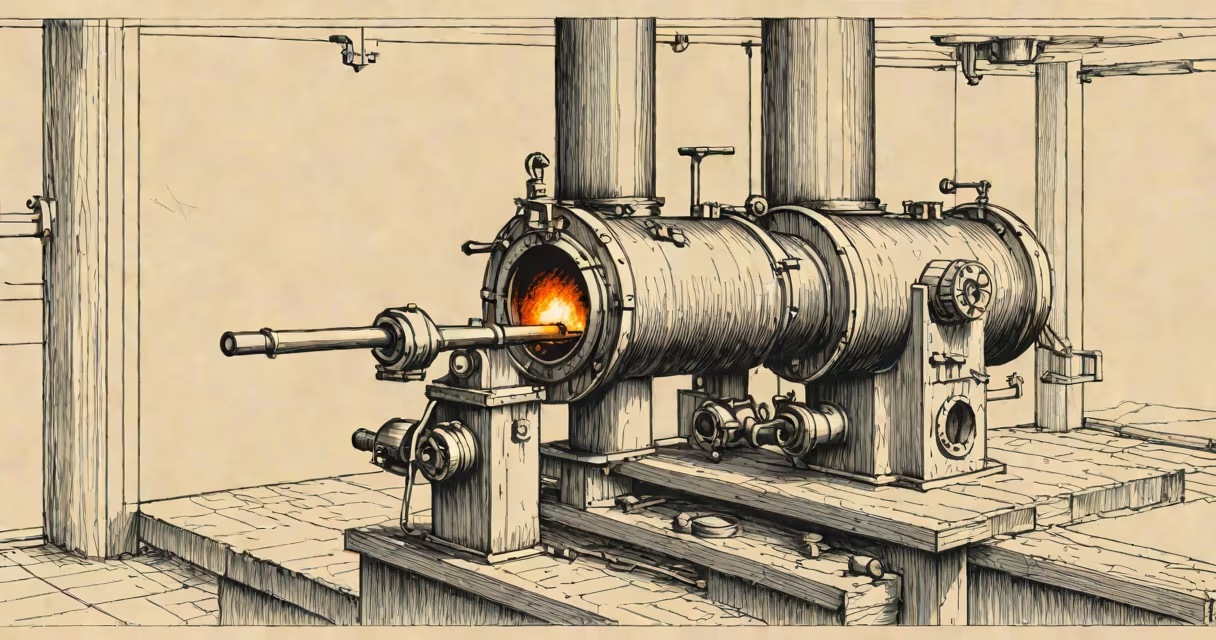
A pyrometer is a non-contact device that measures high temperatures by detecting infrared radiation emitted from a hot surface. It operates based on Planck's law of black-body radiation, converting thermal emissions into accurate temperature readings without physical contact.
Unlike traditional thermometers that require direct contact with a heat source, a pyrometer captures radiant energy from objects above ~500°C. This makes it ideal for measuring molten metals, furnace interiors, and moving parts in industrial processes where contact sensors would fail or degrade quickly.
Pyrometers are essential in steel production, glass manufacturing, and semiconductor processing. They provide real-time feedback for process control, preventing overheating, material defects, and safety hazards. The most common type uses infrared (IR) sensing technology, though some models rely on visible or ultraviolet light in extreme conditions.
How It Works
Every object above absolute zero emits electromagnetic radiation. As temperature increases, the intensity and peak wavelength of this radiation shift toward shorter wavelengths. A pyrometer detects the intensity of infrared radiation within a specific spectral band and calculates temperature using calibrated algorithms derived from Planck's radiation law.
The device focuses infrared energy from the target onto a detector-typically a thermopile, photodiode, or bolometer. The detector converts the incoming radiation into an electrical signal proportional to the object's temperature. Modern pyrometers apply emissivity corrections based on known material properties to improve accuracy.
For example, a pyrometer set to measure steel at 1,200°C accounts for steel's emissivity of approximately 0.65. If uncorrected, the reading could be off by over 100°C. Industrial systems often store emissivity values for common materials in their software databases to automate calibration.
Types and Applications
Pyrometers fall into two primary categories: spot pyrometers and scanning pyrometers. Spot units measure temperature at a single point, while scanning models track temperature across a moving surface, such as a continuous metal sheet during rolling.
| Type | Spectral Range | Best For | Example Use Case |
|---|---|---|---|
| Short-Wave (0.7-1.1 μm) | Visible to near-IR | High-temp metals, molten glass | Measuring steel ingots in a blast furnace |
| Mid-Wave (1.6-2.2 μm) | Mid-IR | Ceramics, refractories | Monitoring kiln walls in ceramic production |
| Long-Wave (8-14 μm) | Far-IR | Lower-temp surfaces, plastics | Tracking plastic extrusion lines |
Some pyrometers use dual-wavelength detection to reduce errors caused by dust, steam, or partial obstructions. By comparing signals at two different wavelengths, they can compensate for interference and maintain accuracy even in harsh environments.
In semiconductor wafer processing, pyrometers monitor annealing temperatures in vacuum chambers. A 2021 study published in Journal of Applied Physics showed that using a long-wave pyrometer reduced thermal gradient variation by 18% compared to contact probes, improving yield rates in silicon doping processes.
Common Misconceptions and Technical Limits
Many assume pyrometers measure "surface temperature" directly. But they actually infer temperature from radiated energy. Accuracy depends heavily on correct emissivity settings. Using a default value of 0.95 for all materials leads to significant errors-especially with shiny metals like aluminum or copper, which have emissivities below 0.1.
Another misconception is that pyrometers work equally well at all distances. In reality, distance-to-spot ratio matters. A typical industrial pyrometer may have a 30:1 ratio-meaning at 30 meters, it measures a 1-meter diameter area. If the target is smaller than the spot size, the reading averages surrounding cooler areas, leading to underestimation.
I once observed a misread in a steel mill where a pyrometer mounted too far from a rolling slab gave a false low reading. The system failed to detect a localized cooling zone until a defect appeared in the final product. Adjusting the sensor position and recalibrating emissivity corrected the issue. This incident underscores why proper installation and configuration are critical.
Key Distinctions
Pyrometers are often confused with infrared thermometers, but the latter are typically lower-cost devices used for medical or HVAC applications. While both use IR detection, pyrometers are designed for higher temperatures (>500°C), greater precision, and integration into automated control systems.
They also differ from thermocouples and resistance temperature detectors (RTDs), which require physical contact. Contact sensors can respond faster to sudden changes but degrade rapidly in high-heat environments. A thermocouple exposed to molten steel melts within minutes; a pyrometer remains operational indefinitely.
For accurate results, always verify the pyrometer's operating range and spectral response against the application. A short-wave pyrometer won't work well on a cold ceramic tile-it lacks sensitivity at low temperatures. Conversely, a long-wave model may struggle with very hot metals due to saturation effects.
According to the National Institute of Standards and Technology (NIST), pyrometers used in industrial settings must be recalibrated annually to maintain traceability to international temperature standards. Calibration involves comparing readings against black-body furnaces at known temperatures, ensuring compliance with ISO 13526 standards for non-contact temperature measurement.
When selecting a pyrometer, consider environmental factors: ambient temperature, dust, moisture, and vibration. Some models feature air purge systems to keep optics clean in dusty factories. Others use fiber-optic guides to route signals away from heat zones.
Final Insight
What is pyrometer? It is a precise, non-contact tool for measuring temperature in extreme or inaccessible environments. Its ability to deliver real-time data without physical interaction makes it indispensable in modern industry.
Understanding its limitations-especially around emissivity, distance, and spectral range-prevents costly errors. Always match the device to the material, temperature range, and environment. When used correctly, a pyrometer ensures quality, safety, and efficiency in high-stakes operations.