
treaty of versailles consequences for germany
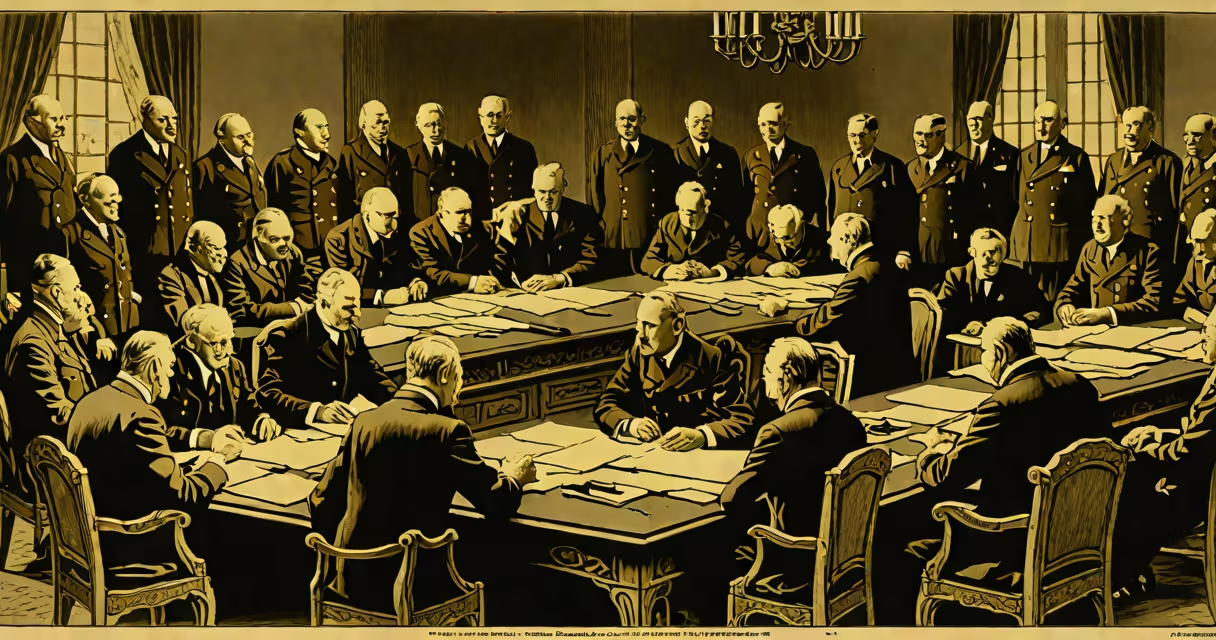
The Treaty of Versailles consequences for Germany included territorial cessions, military disarmament, financial reparations totaling 132 billion gold marks, and the formal assignment of war guilt through Article 231, all of which destabilized the Weimar Republic and contributed to the rise of Nazi Germany.
Germany was required to cede 13% of its pre-war territory after World War I. This included Alsace-Lorraine to France, Eupen-Malmedy to Belgium, Northern Schleswig to Denmark, and parts of Prussia to Poland. The Saar Basin was placed under League of Nations administration for 15 years, with its coal mines managed by France. These changes reduced Germany's industrial capacity and disrupted regional economies.
Military restrictions were severe. Germany's army was limited to 100,000 troops, conscription was banned, and the navy was restricted to six battleships and no submarines. The Rhineland was demilitarized, and Allied forces occupied the region until 1930. These measures were intended to prevent future aggression but were widely seen in Germany as humiliating and punitive.
| Consequence Type | Specific Requirement | Impact on Germany |
|---|---|---|
| Territorial Losses | 13% of land, including resource-rich regions | Loss of coal and iron resources; population displacement |
| Reparations | 132 billion gold marks (approx. $33 billion USD in 1920s) | Hyperinflation in 1923; national debt crisis |
| Military Restrictions | Army capped at 100,000; no air force or submarines | Perceived national humiliation; military innovation underground |
| War Guilt Clause | Article 231 assigned sole responsibility for the war | Political outrage; used by nationalists to discredit Weimar government |
Reparations were set at 132 billion gold marks in 1921, equivalent to about $33 billion in 1920s U.S. dollars. By 1923, Germany defaulted on payments due to hyperinflation, which erased savings and destroyed middle-class stability. The Ruhr Valley was occupied by French and Belgian troops in response, leading to passive resistance and further economic collapse. The crisis culminated in the hyperinflation of 1923, when the mark lost nearly all value-prices doubled daily, and people carried wheelbarrows of cash to buy bread.
Article 231, the "war guilt" clause, explicitly stated that Germany and its allies were responsible for causing the war. This was not a legal finding of criminal guilt but a diplomatic tool to justify reparations. German officials rejected it as unjust, and it became a central theme in nationalist propaganda. Adolf Hitler cited it repeatedly during his rise, calling it a "Diktat" (dictated peace) imposed by victors.
Many historians, including Niall Ferguson in The Pity of War, argue that the treaty's harshness was disproportionate to Germany's actual wartime conduct. Britain and France had also engaged in aggressive actions, such as the naval blockade that starved millions in Central Europe. Yet Germany bore the full burden. The treaty ignored the role of alliance systems and arms races in sparking the conflict.
A lesser-known consequence was the psychological toll. The treaty's terms were widely perceived as a national betrayal. The term "stab-in-the-back myth" (Dolchstoßlegende) emerged, claiming that Germany had not been defeated on the battlefield but betrayed by civilians and politicians at home. This narrative helped legitimize extremist movements and undermined faith in democratic institutions.
When the Nazis came to power in 1933, they immediately began dismantling the treaty's constraints. In 1936, Hitler remilitarized the Rhineland-a direct violation of Versailles. He withdrew Germany from the League of Nations and the Disarmament Conference. By 1939, the country had rebuilt its military and launched World War II.
During my research trip to the German Historical Museum in Berlin, I saw original documents from 1919, including the draft of Article 231. The handwriting was shaky, reflecting the exhaustion of the negotiators. One note in the margin read: "This will not be accepted." That single line captured the emotional weight of the moment-not just a legal clause, but a rupture in national identity.
Some critics confuse the Treaty of Versailles with the Treaty of Saint-Germain or the Treaty of Trianon, which dealt with Austria and Hungary. The Treaty of Versailles specifically addressed Germany. The other treaties were separate and applied to different states. Misattributing terms between them leads to inaccurate historical analysis.
Another common error is assuming the treaty caused the Great Depression. While reparations strained the economy, the global financial collapse began in 1929, long after the treaty was signed. The U.S. stock market crash and bank failures in Europe were unrelated to Versailles. However, the treaty did exacerbate existing vulnerabilities in Germany's fragile democracy.
For context, the United States Senate never ratified the Treaty of Versailles. President Woodrow Wilson's vision of a peaceful world order under the League of Nations failed without American participation. The absence of U.S. support weakened the treaty's enforcement mechanisms and diminished its legitimacy in international law.
Germany's acceptance of the treaty was not unanimous. The Weimar government signed under duress, knowing that refusal would lead to renewed hostilities. The Allies threatened to occupy the Ruhr again if Germany refused. The decision was made not out of principle but necessity.
Today, the Treaty of Versailles consequences for Germany are studied as a cautionary tale in international relations. Scholars like Margaret MacMillan, in Paris 1919, emphasize that the treaty's failure stemmed not from its terms alone but from the lack of reconciliation. Peace was imposed, not negotiated. Trust was not rebuilt.
Understanding the treaty's full impact requires separating cause from effect. The economic hardship in the 1920s was real, but it was compounded by external factors like the 1929 crash and domestic political fragmentation. The treaty was a catalyst, not a sole cause.