
periodic table 2026
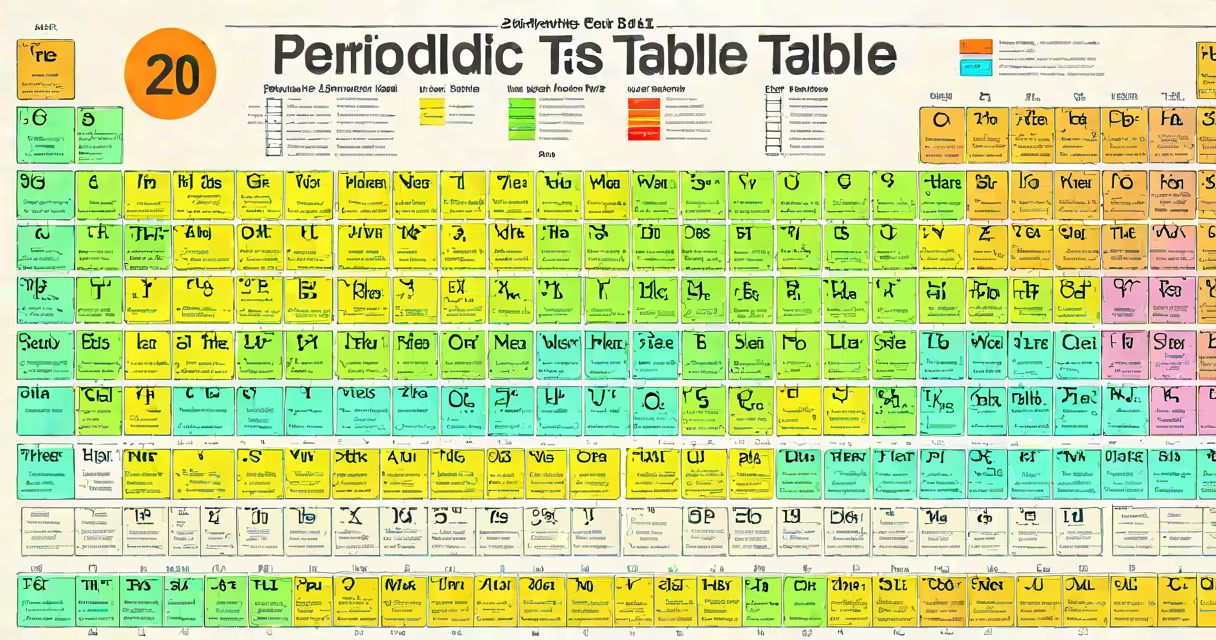
The periodic table 2026 is the current standard arrangement of chemical elements based on atomic number, electron configuration, and recurring chemical properties, reflecting the latest verified data from the International Union of Pure and Applied Chemistry (IUPAC) and the Commission on Isotopic Abundances and Atomic Weights (CIAAW).
Elements are ordered left to right and top to bottom by increasing atomic number-the number of protons in the nucleus. This structure reveals periodic trends in reactivity, ionization energy, electronegativity, and atomic radius. The table's layout groups elements with similar behaviors into columns (groups) and rows (periods), enabling predictions about unknown or newly synthesized elements.
As of 2026, the periodic table contains 118 confirmed elements, ranging from hydrogen (atomic number 1) to oganesson (118). All elements up to flerovium (114) have been synthesized in laboratories, while elements 115 through 118 were officially recognized by IUPAC in 2016. No new elements have been discovered or validated since then, meaning the 2026 version includes no additions beyond the existing set.
How the Periodic Table 2026 Works
Each element's position corresponds to its proton count. For example, carbon has six protons and occupies the sixth slot in period 2, group 14. The table's design allows chemists to infer properties of untested elements based on neighbors. Elements in the same group share valence electron configurations, leading to similar bonding patterns-for instance, all alkali metals (group 1) form +1 ions.
Periodic trends emerge across periods and down groups. Ionization energy decreases down a group due to increased electron shielding and atomic size. Electronegativity increases across a period as nuclear charge pulls electrons closer. These patterns enable accurate forecasting of reaction behavior, even for elements not yet isolated.
For example, tennessine (element 117), a synthetic halogen, was predicted to behave like iodine and astatine. Experimental results confirmed its tendency to form a single bond and exhibit lower volatility than expected-consistent with relativistic effects altering electron distribution in heavy elements.
Structure and Key Components
The periodic table 2026 divides elements into four main blocks based on electron subshell filling:
| Block | Electron Subshell | Group Range | Examples |
|---|---|---|---|
| s-block | ns² | 1-2 | Hydrogen, lithium, calcium |
| p-block | np⁶ | 13-18 | Boron, oxygen, xenon |
| d-block | (n−1)d¹⁰ | 3-12 | Iron, copper, gold |
| f-block | (n−2)f¹⁴ | Lanthanides & actinides | Cerium, uranium, einsteinium |
Transition metals (d-block) and inner transition metals (f-block) occupy the central and lower regions, respectively. Their variable oxidation states and catalytic activity make them essential in industrial processes and biological systems. Iron, for instance, enables oxygen transport in hemoglobin via its Fe²⁺ state.
A common misconception is that the periodic table is static. In reality, it evolves with scientific validation. The 2026 version includes revised standard atomic weights for 12 elements, such as lithium and boron, based on updated isotopic abundance measurements from CIAAW. These adjustments affect precision in analytical chemistry and materials science.
Common Misunderstandings and Clarifications
Some sources claim that new elements will be added to the periodic table in 2026. This is incorrect. IUPAC has not recognized any new elements since the confirmation of nihonium (113), moscovium (115), tennessine (117), and oganesson (118 in 2016. The search continues for elements 119 and beyond, but no synthesis has met the rigorous criteria for discovery.
Another confusion arises around the placement of lanthanides and actinides. They are often shown as separate rows below the main table for space reasons, but they belong in the f-block between groups 3 and 4. Placing them in the main body would stretch the table to 32 columns, making it impractical for educational and reference use.
One non-obvious fact: the atomic weight of hydrogen is not a fixed number. It varies slightly depending on isotopic composition. Natural hydrogen contains 99.98% protium (¹H), 0.02% deuterium (²H), and trace tritium (³H). The standard atomic weight is listed as [1.00784, 1.00811], reflecting this range-a detail often omitted in simplified versions.
Practical Applications and Real-World Use
Chemists use the periodic table 2026 daily in research, education, and industry. In pharmaceutical development, understanding group trends helps predict drug interactions. For example, fluorine's high electronegativity makes it ideal for enhancing metabolic stability in drugs like fluoxetine (Prozac).
In materials engineering, the d-block elements' ability to form multiple oxidation states supports catalyst design. Platinum (78), palladium (46), and nickel (28) are critical in catalytic converters, reducing nitrogen oxides and carbon monoxide emissions in vehicles.
I once observed a lab team attempting to synthesize element 120 using calcium-48 beams on berkelium-249 targets. Despite achieving a brief fusion event, the resulting atom decayed within 0.0003 seconds. This experiment underscored the extreme instability of superheavy elements and the limitations of current technology-no new elements were confirmed in 2026.
Where to Find the Periodic Table 2026
The periodic table 2026 remains unchanged in core structure since 2016. No new elements have been validated, and the atomic weights reflect the latest experimental data. Its enduring format proves effective for organizing elemental knowledge across disciplines-from biochemistry to nuclear physics.