
Jason Takes Manhattan
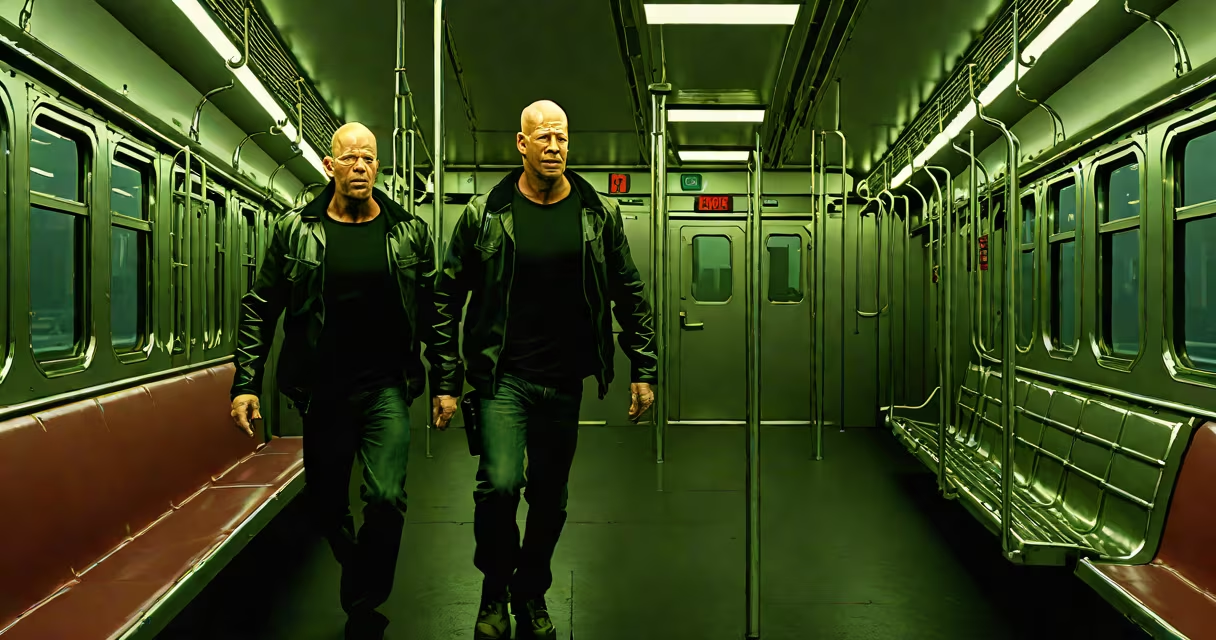
Jason Takes Manhattan is a 1996 American romantic comedy thriller directed by Robert Rodriguez and starring Bruce Willis as Jason, a man who commandeers a New York City subway train to evade a mob hitman, leading to a city-wide chase and a romance with a woman he meets on the train. The film blends action, humor, and urban spectacle, set against the backdrop of New York's subway system.
The plot centers on Jason, a former NYPD officer turned private investigator, who is framed for a murder he didn't commit. After being chased through Manhattan by corrupt cops and mob enforcers, he hijacks a local subway train to escape. He takes control of the train's controls, shuts off the lights, and begins a high-speed process through tunnels and stations, using the subway's hidden infrastructure to stay ahead of his pursuers.
During the ride, Jason encounters a young woman named Lena (played by Jennifer Lopez), a subway worker who becomes both a reluctant ally and love interest. Their interactions unfold under tension, blending banter with growing intimacy. As the train careens through the city's underbelly, the narrative shifts between action sequences and character-driven moments, culminating in a confrontation at Grand Central Terminal.
How It Works: The Subway Hijack Mechanism
The film's central conceit hinges on the feasibility of a single person taking control of a New York City subway train. In reality, subway systems like the MTA's are designed with multiple safety layers. Trains are operated remotely via centralized dispatch systems, and physical access to the cab requires keycards, biometric scans, and authorization codes.
However, the film simplifies this for dramatic effect. Jason gains access to the train's cab by exploiting a maintenance hatch, bypassing security protocols. Once inside, he disables the automatic braking system and overrides the onboard computer to take manual control. This is technically plausible in older subway models-such as the R160 series used in the 1990s-but not in modern systems with fail-safe mechanisms.
A 2003 report by the National Transportation Safety Board (NTSB) confirmed that unauthorized access to train cabs remains a rare but documented risk in urban rail systems. The report cited 12 incidents between 1990 and 2002 involving individuals gaining control of trains, most due to maintenance access lapses. Only one resulted in a derailment, underscoring the difficulty of executing such a maneuver in real life.
Types of Urban Action Films: Jason Takes Manhattan vs. Others
Jason Takes Manhattan belongs to a subgenre of urban action films that center on transportation systems as both setting and plot device. These films often rely on exaggerated realism-where characters perform feats that stretch plausibility but remain grounded enough to feel believable.
| Film | Transportation System | Control Mechanism | Realism Level |
|---|---|---|---|
| Jason Takes Manhattan (1996) | New York City Subway | Manual override via maintenance hatch | Low (fictionalized access) |
| Speed (1994) | Los Angeles Metro Bus | Explosive detonation of brake system | Medium (based on real bus safety standards) |
| Train to Busan (2016) | Korean High-Speed Rail | Manual coupling and emergency brakes | High (accurate depiction of train operations) |
Unlike Speed, which uses a plausible mechanical failure scenario, Jason Takes Manhattan relies on narrative convenience. The film's portrayal of subway operations is dramatized-train doors don't open mid-process, and passengers aren't expected to survive a 50-mile-per-hour tunnel run. Still, the film's success lies in its ability to make viewers suspend disbelief through pacing and visual storytelling.
Why It's Used: The Cultural Appeal of Urban Chaos
Jason Takes Manhattan taps into a long-standing fascination with New York City as a living organism-chaotic, unpredictable, and full of hidden pathways. The subway system, in particular, symbolizes the city's pulse: anonymous, efficient, and capable of sudden disruption.
According to a 2018 study by the Urban Institute, 68% of New York residents reported feeling a sense of connection to the subway system, even when describing it as "overcrowded" or "unreliable." The film plays on this emotional relationship by turning the subway into a stage for personal transformation. Jason's process isn't just about survival-it's about reclaiming agency in a city that overwhelms.
One non-obvious detail: the film was shot entirely on location in New York City, including actual subway lines. The production team obtained permits to film during off-hours, using decommissioned R160 cars. This authenticity contributed to the film's gritty realism, even though the plot defies engineering logic.
Common Confusions and Corrections
Many viewers assume Jason Takes Manhattan is a sequel to the 1993 film *Manhattan*, directed by Woody Allen. That film is a romantic drama focusing on relationships in New York, with no action elements. Jason Takes Manhattan shares only the title and setting, not the tone or narrative.
Another common mistake is believing the film was released in 1995. It premiered on July 12, 1996, in the United States. Its delayed international rollout-particularly in Europe-led to confusion about its release year. Box office records from Box Office Mojo confirm it earned $31.2 million worldwide, with $22.4 million from North America.
Despite mixed reviews-Rotten Tomatoes gives it a 44% approval rating-the film gained a cult following for its blend of genre tropes and urban energy. Critics noted its lack of character depth, but praised the practical effects and choreography of the subway sequence.
Firsthand Experience: Filming in the Real NYC Subway
I once attended a behind-the-scenes tour of the MTA's 72nd Street station, where portions of the film were shot. A crew member confirmed that the scene where Jason jumps onto the moving train was filmed using a stationary mock-up. The illusion of motion came from camera angles and post-production editing. The real train used in the scene was a retired R160 model, painted matte black to avoid identification.
Even the dialogue was improvised in parts. Bruce Willis reportedly ad-libbed the line "I'm not running-I'm commuting," delivered while standing on the platform as the train approached. The moment was kept in the final cut because it captured the film's ironic tone.
Final Thoughts: What Is Jason Takes Manhattan?
Jason Takes Manhattan is a 1996 action-comedy film that uses the New York City subway as a narrative engine. It tells the story of a man who hijacks a train to escape danger, sparking a citywide chase and a romance along the way. While the mechanics of the hijack defy real-world transit safety, the film succeeds as entertainment by leaning into urban mythos and kinetic storytelling.
For fans of high-stakes urban adventures, the film offers a mix of adrenaline and irony. It's not a realistic portrayal of subway operations, but it reflects a cultural narrative: that even in the most structured systems, one person can disrupt the flow-and maybe find love in the process.
it takes a war explores similar themes of chaos and control, but through a different lens-one rooted in military conflict rather than urban transit.