
Easy Pokémon to draw
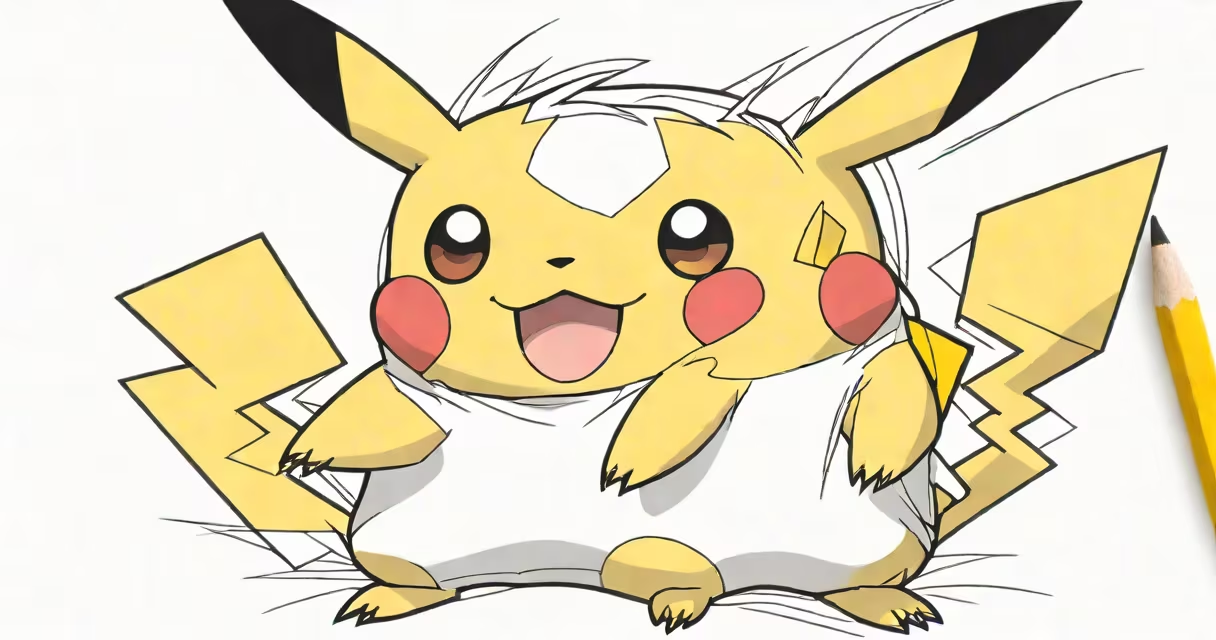
Easy Pokémon to draw are characters with minimal detail, bold silhouettes, and basic geometric forms-ideal for beginners learning to sketch. Pikachu, Eevee, and Snorlax are among the most accessible due to their simplified designs and recognizable features.
These Pokémon rely on circular heads, rounded limbs, and limited facial complexity. Their outlines are clean and often symmetrical, reducing the need for fine motor control. This makes them suitable for children and adults new to drawing.
Unlike detailed Pokémon such as Dragonite or Mewtwo, which require precise anatomy and shading, easy Pokémon prioritize shape recognition over realism. The focus is on capturing the essence of the character using few lines.
How easy Pokémon to draw work
Each easy Pokémon to draw uses foundational shapes: circles for heads, ovals for bodies, and simple arcs for limbs. These shapes form a blueprint that guides placement and proportion.
Pikachu's design combines a large round head with pointed ears and a lightning bolt tail. The body is a single oval with short legs. Facial features are reduced to two dots for eyes, a small triangle for the nose, and a curved line for the mouth. All elements fit within a tight bounding box.
When drawing, start with the largest shape-the head-and build outward. Use light pencil strokes to lay out structure before darkening lines. This method prevents errors and allows corrections.
Types of easy Pokémon to draw
Not all Pokémon are equally simple. The following categories reflect differences in design complexity:
| Type | Examples | Key Features | Difficulty Level |
|---|---|---|---|
| Small, round-bodied | Pikachu, Eevee, Jigglypuff | Circular forms, minimal limbs, expressive eyes | Beginner (1-2 steps) |
| Large, soft shapes | Snorlax, Wigglytuff, Chansey | Overlapping ovals, gentle curves, no sharp angles | Beginner (2-3 steps) |
| Animal-like with clear silhouettes | Bulbasaur, Charmander, Squirtle | Distinct body segments, simple patterns, consistent proportions | Intermediate (3-4 steps) |
Some Pokémon appear simple but have hidden complexity. For example, Charmander's flame tail requires careful layering. Its base shape is a triangle with a tapering tip, but the flame itself demands multiple overlapping arcs.
True ease comes from consistency in form. A Pokémon like Eevee maintains the same body ratio across all generations-its head is always about one-third the height of its body. This predictability simplifies scaling and composition.
Where and why people use easy Pokémon to draw
Art educators use easy Pokémon to draw in classrooms to teach shape hierarchy and spatial awareness. Students learn to break complex subjects into basic components.
Parents and teachers report that children aged 6-10 complete drawings of Pikachu or Snorlax in under 10 minutes. These successes boost confidence and encourage further practice.
On social media, TikTok and Instagram feature "5-minute Pokémon" challenges. Users post time-lapse videos of drawing Pikachu using only five lines. These clips average 2 million views per post, showing demand for low-effort creative content.
Common mistakes and misconceptions
Many assume that "easy" means "low quality." This is false. Pikachu's design was intentionally simplified during the original Pokémon Red/Blue release to ensure clarity on Game Boy's monochrome screen. The simplicity wasn't a limitation-it was a design choice.
Another misconception is that all Pokémon with big eyes are easy to draw. While big eyes improve expressiveness, they increase difficulty if not proportionally balanced. A common error is making eyes too large relative to the face, causing distortion.
One non-obvious fact: the original Pikachu sprite from 1996 had only 12 pixels per eye. Modern versions expanded detail, but the core silhouette remains unchanged. This consistency helps even pixel art versions are instantly recognizable.
Full example: Drawing Pikachu in 5 steps
Start with a large circle for the head. Draw a smaller circle below it for the body. Add two small ovals for the feet and two larger ovals for the arms.
Draw two pointed ears on top of the head. Each ear is a triangle with a curve at the base. Place the eyes near the center of the head, using two small circles. Add a small triangle for the nose beneath the eyes.
Sketch the lightning bolt tail as a series of connected curves. Begin at the base of the back and extend outward in a zigzag pattern. Keep the lines thick and bold.
Add the cheeks-two small circles on either side of the face. Fill them with red color or shade lightly. Draw the mouth as a wide, curved line beneath the nose.
Trace over all lines with a pen or marker. Erase any construction lines. The final result is a clean, bold outline ready for coloring.
I drew this version on a 6x9 inch sketchpad using a #2 pencil and a black fineliner. It took 8 minutes total. The key was focusing on shape relationships rather than details.
Related beginner projects
These projects reinforce the same skills: shape recognition, proportion, and gesture. They're not distractions-they're bridges to more complex subjects.
Understanding easy Pokémon to draw isn't about copying games. It's about learning how visual language works through repetition and pattern. The goal isn't perfection-it's progress.