
Define a Mixture
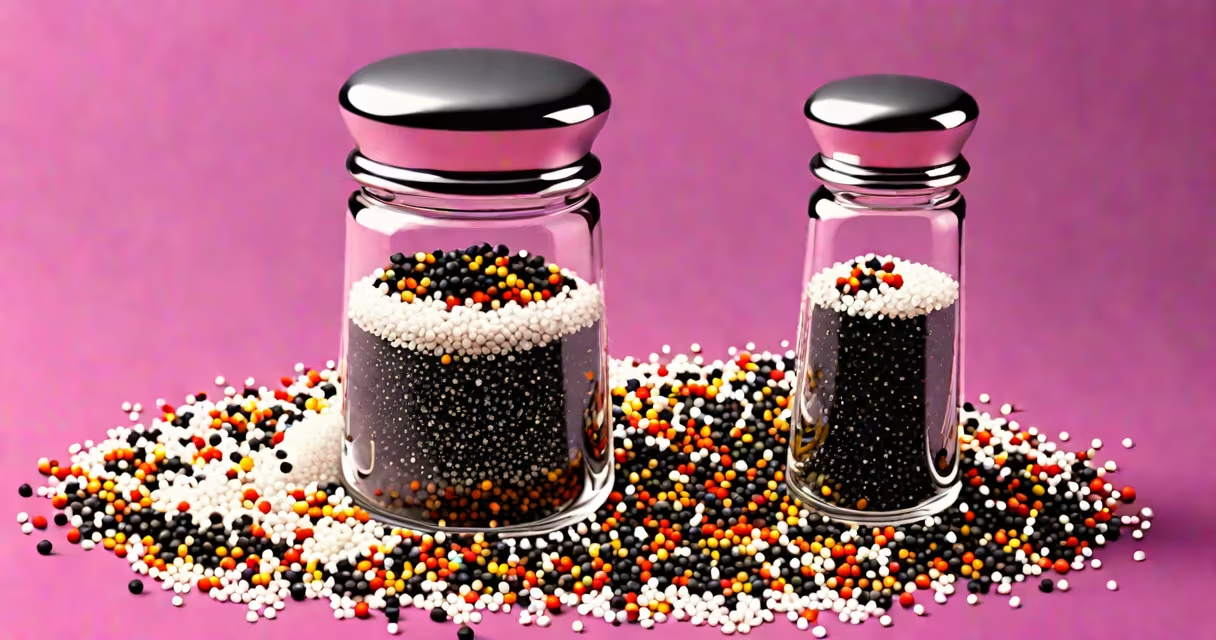
A mixture is a physical combination of two or more substances that retain their individual chemical identities and can be separated by physical means. No new compound forms during mixing.
Mixtures form when materials blend without undergoing chemical reactions. Each component keeps its original properties-like salt's taste or iron filings' magnetism-even after being combined. This distinguishes mixtures from compounds, where atoms bond chemically and form new substances.
For example, stirring sugar into coffee creates a mixture. The sugar dissolves but remains sucrose. You can recover it by boiling off the water. The process reverses completely, proving no chemical change occurred.
How Mixtures Work
When substances mix physically, they don't share electrons or form ionic bonds. Instead, particles intermingle through dispersion, dissolution, or mechanical blending. Separation relies on differences in physical traits such as boiling point, solubility, or particle size.
Common separation techniques include filtration (for solids in liquids), distillation (based on boiling points), evaporation (removing a solvent), and magnetic attraction (for ferromagnetic materials).
For instance, filtering muddy water removes soil particles while letting water pass. The filter doesn't alter the water's chemistry-it only blocks larger particles. After filtering, the water is still H₂O.
Types of Mixtures
There are two main categories: homogeneous and heterogeneous. Homogeneous mixtures have uniform composition throughout. Heterogeneous mixtures show visible differences between parts.
| Type | Composition | Examples | Separation Method |
|---|---|---|---|
| Homogeneous | Uniform at molecular level | air, saltwater, brass alloy | distillation, evaporation |
| Heterogeneous | Visibly distinct phases | sand and water, oil and vinegar, trail mix | filtration, decanting, centrifugation |
Homogeneous mixtures are often called solutions. They appear as single-phase systems-like clear saltwater-but contain multiple substances. The dissolved salt doesn't react with water; it just disperses evenly.
Some mixtures seem uniform but aren't. Mayonnaise is a classic example. It looks smooth but contains oil droplets suspended in water. It's a colloid-a type of heterogeneous mixture where particles are small enough to stay dispersed but large enough to scatter light.
Where and Why Mixtures Are Used
Everyday products rely on mixtures. Cooking uses them constantly-baking soda and flour in dough, vinegar and oil in salad dressing. Industrial processes depend on them too: gasoline blends different hydrocarbons, and concrete mixes cement, sand, gravel, and water.
Environmental science uses mixtures to model natural systems. Air is a gaseous mixture of nitrogen (78%), oxygen (21%), argon (0.9%), and trace gases. Scientists analyze air quality by measuring pollutant concentrations within this stable mixture.
Pharmaceuticals use precise mixtures. A tablet may contain an active ingredient (like acetaminophen), a binder (lactose), and a coating (polyethylene glycol). Each substance performs a role without reacting chemically.
Common Misconceptions
People often confuse mixtures with compounds. A compound forms when elements react-like hydrogen and oxygen combining into water (H₂O). That's a new substance with different properties. Mixtures don't do this.
Another error is assuming all mixtures are uniform. Trail mix, for example, contains nuts, raisins, and chocolate chips. You can see each piece. Even though it's stirred, the components remain separate. This makes it heterogeneous.
Even some textbooks mislabel colloids as homogeneous. Colloids like milk or fog appear uniform but contain dispersed particles. They're stable due to Brownian motion, not because they're truly uniform. This distinction matters in material science and food processing.
Real-World Example: Seawater
Seawater is a complex mixture. It contains sodium chloride (3.5%), magnesium, calcium, potassium, and dissolved gases. All substances remain chemically unchanged. Salinity varies by location but stays within measurable ranges.
To extract salt, seawater undergoes solar evaporation. Water evaporates, leaving behind solid NaCl. The process reverses the mixture without altering the chemical identity of either component. This method has been used since ancient times-Roman soldiers collected brine from coastal pools to make salt.
Modern desalination plants use reverse osmosis. High pressure forces water through membranes that block salts and minerals. The result is fresh water and concentrated brine. Both outputs are pure substances derived from a mixture.
Firsthand Observation
I once mixed iron filings and sulfur powder in a beaker. The mixture looked grayish-black. When I passed a magnet over it, the iron filings stuck to the magnet and pulled out. The sulfur remained. I then heated the mixture. It turned red-hot and released a smell of rotten eggs-hydrogen sulfide gas formed. That reaction created a compound, not a mixture. The original mixture was separable; the product was not.
This experiment confirmed that mixtures are reversible by physical means. Compounds require chemical energy to break apart.
Key Distinction: Mixtures vs. Compounds
Compounds form through chemical bonding. Their elements lose individual properties. Water (H₂O) boils at 100°C and freezes at 0°C-different from hydrogen (flammable gas) or oxygen (supports combustion).
Mixtures don't create new properties. Saltwater conducts electricity because of ions, not because water changed. Adding salt increases conductivity, but the water molecule remains intact.
According to the National Institute of Standards and Technology (NIST), mixtures are defined by their lack of chemical change. The University of Wisconsin Chemistry Department confirms that physical separation methods confirm a system is a mixture, not a compound.
Conclusion
Define a mixture as a blend of substances that do not chemically react. Components maintain their identities and can be separated using physical methods. From air to trail mix, mixtures underpin daily life and industrial processes. Understanding them prevents confusion with compounds and supports accurate scientific reasoning.