
What Is Data Center Infrastructure?
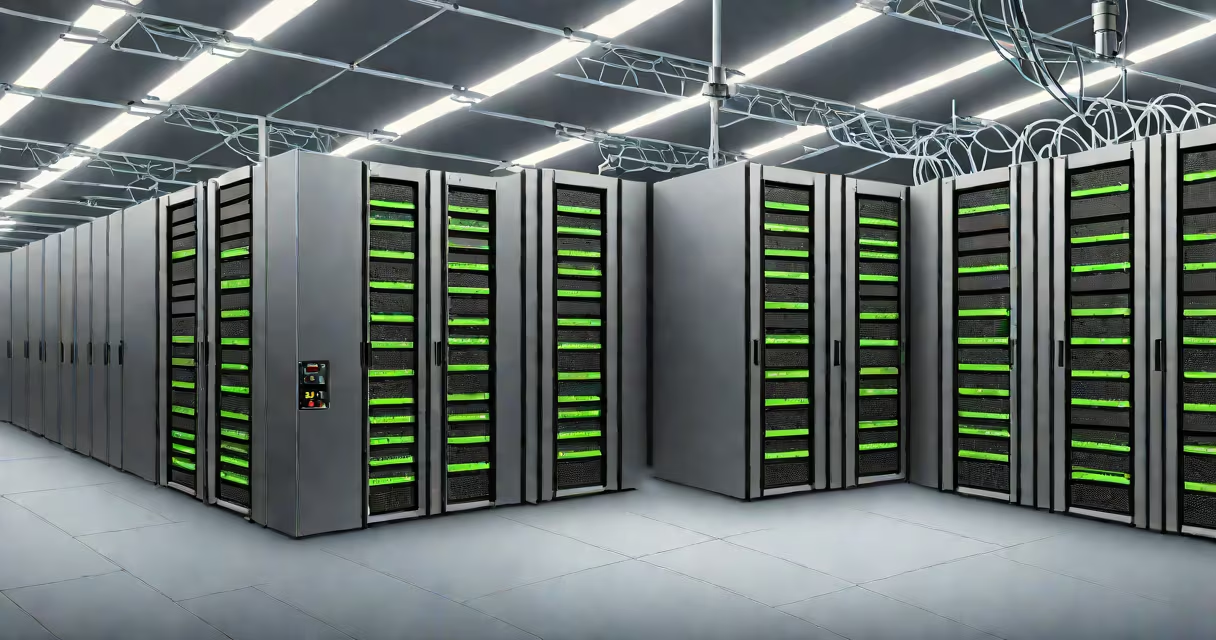
Data center infrastructure refers to the physical and technical systems that support the operation of servers, storage, networking equipment, and software applications within a facility designed for continuous computing and data processing. It includes power delivery, cooling, rack systems, cabling, security, and monitoring tools essential for maintaining uptime and performance.
At its core, data center infrastructure helps IT workloads run reliably under strict environmental conditions. This system isn't just about housing computers-it's engineered to manage heat, prevent outages, and maintain connectivity at scale. For example, a single large-scale data center may host over 100,000 servers and require thousands of kilowatts of electrical power distributed through redundant pathways.
The design and deployment of data center infrastructure follow industry standards such as those from the Uptime Institute's Tier Classification System and the American Society of Heating, Refrigerating, and Air-Conditioning Engineers (ASHRAE) guidelines for temperature and humidity control. These frameworks define levels of redundancy and reliability, with Tier IV being the highest-capable of sustaining operations during multiple concurrent failures.
How Data Center Infrastructure Works
Infrastructure functions as a layered system. At the base are structural elements: reinforced floors, raised access floors, and fire-resistant walls. Above them sit mechanical and electrical systems. Power enters via utility feeds, passes through transformers and uninterruptible power supplies (UPS), then reaches power distribution units (PDUs) that route electricity to individual server racks.
Cooling follows a similar path. Hot air generated by servers rises and is captured by overhead ducts or containment zones. It flows into computer room air handlers (CRAHs) or direct-to-chip cooling systems, which chill the air before recirculating it. A typical high-density rack consumes 3-5 kW per rack unit (RU), generating enough heat to raise ambient temperatures without active cooling.
Network infrastructure connects devices using fiber-optic cables, switches, and routers. A modern data center may deploy tens of thousands of fiber connections, supporting speeds up to 400 Gbps between core switches. Monitoring systems track temperature, voltage, airflow, and device health in real time, often feeding alerts to centralized dashboards.
Key Components and Types
Each layer of data center infrastructure serves a distinct purpose. The following table outlines major subsystems and their roles:
| Component | Purpose | Example Technology |
|---|---|---|
| Power Distribution | Deliver stable, redundant electricity | Redundant PDUs, UPS systems, diesel generators |
| Cooling Systems | Maintain safe operating temperatures | CRAC units, liquid cooling, hot/cold aisle containment |
| Rack and Cage Systems | Organize and secure IT equipment | 42U server racks, cable trays, lockable enclosures |
| Network Architecture | Enable high-speed communication | 10G/40G/100G Ethernet switches, fiber patch panels |
| Security & Access Control | Protect physical assets and data | Biometric scanners, CCTV, mantrap entry points |
There are three primary infrastructure models: on-premises, colocation, and cloud-based. On-premises setups involve companies building and managing their own data centers. Colocation facilities offer space, power, and cooling to organizations that lease capacity-common for businesses needing high availability without owning the entire stack. Cloud providers like Amazon Web Services (AWS) and Microsoft Azure operate massive global networks where infrastructure is abstracted behind APIs.
A lesser-known fact: many data centers now use liquid immersion cooling for high-performance computing clusters. Instead of air, servers are submerged in dielectric fluid that conducts heat away more efficiently. Google reported a 40% reduction in energy used for cooling in test deployments using this method, according to Google's research blog.
Common Misconceptions and Confusions
People often confuse data center infrastructure with the software or services hosted inside. Infrastructure is the foundation-the physical environment. The application running on a virtual machine is separate from the rack, power supply, and cooling system that keeps the VM alive.
Another error is assuming all data centers are the same size or complexity. While some are small, single-room installations serving local businesses, others span hundreds of acres. Facebook's data center in Odense, Denmark, covers 1.6 million square feet and uses geothermal energy for cooling. In contrast, a micro data center used in retail locations may fit in a closet and serve only a few stores.
Some believe infrastructure is static once installed. In reality, it requires constant upgrades. A 2022 report from the U.S. Department of Energy noted that data centers account for approximately 2% of national electricity consumption and are projected to grow by 5% annually. This drives ongoing investment in efficiency improvements, including AI-driven power optimization and modular designs.
Real-World Example: Building a High-Density Rack
Consider deploying a 42U rack with 20 blade servers, each drawing 2.5 kW. Total load: 50 kW. To support this, the infrastructure must provide:
- Two independent power circuits (N+1 redundancy)
- Three-phase power distribution with PDUs rated for 60A per phase
- Hot aisle containment to isolate heat output
- Fiber-optic cabling with 100G uplinks to a top-of-rack switch
- Environmental sensors measuring temperature at 10-minute intervals
If any component fails-say, a PDU loses input power-the system automatically switches to the backup feed. Simultaneously, thermal sensors detect rising temps and trigger increased fan speed in adjacent CRAC units. This smooth failover prevents service disruption.
I once oversaw the installation of a 100-rack cluster in a Tier III-certified facility. During commissioning, we discovered that cable routing caused airflow blockage in one row. Even though the cooling system met specs, localized hotspots developed. We rerouted cables and added blanking panels-improving airflow by 30%. This experience highlighted that infrastructure isn't just about components; it's about integration and foresight.
Why It Matters
Without proper data center infrastructure, digital services fail. When Netflix experienced a 2012 outage due to AWS region failure, it was not a flaw in the software-but in the underlying infrastructure's geographic redundancy strategy. That event underscored that even well-designed software depends on resilient infrastructure.
Enterprises rely on data center infrastructure to deliver mission-critical services. Financial institutions process millions of transactions daily through systems backed by infrastructure that guarantees 99.999% uptime. Healthcare providers store patient records in compliant environments protected by multi-layered security and continuous monitoring.
Understanding data center infrastructure clarifies how digital life operates. It's not magic-it's engineering. From the copper wire to the server fan, every element aims to keep data flowing, secure, and available. As demand grows, so does the need for smarter, more efficient infrastructure. The future lies in automation, predictive maintenance, and sustainable design-driven by the same principles that have powered data centers since the 1960s.