
What Is Granite
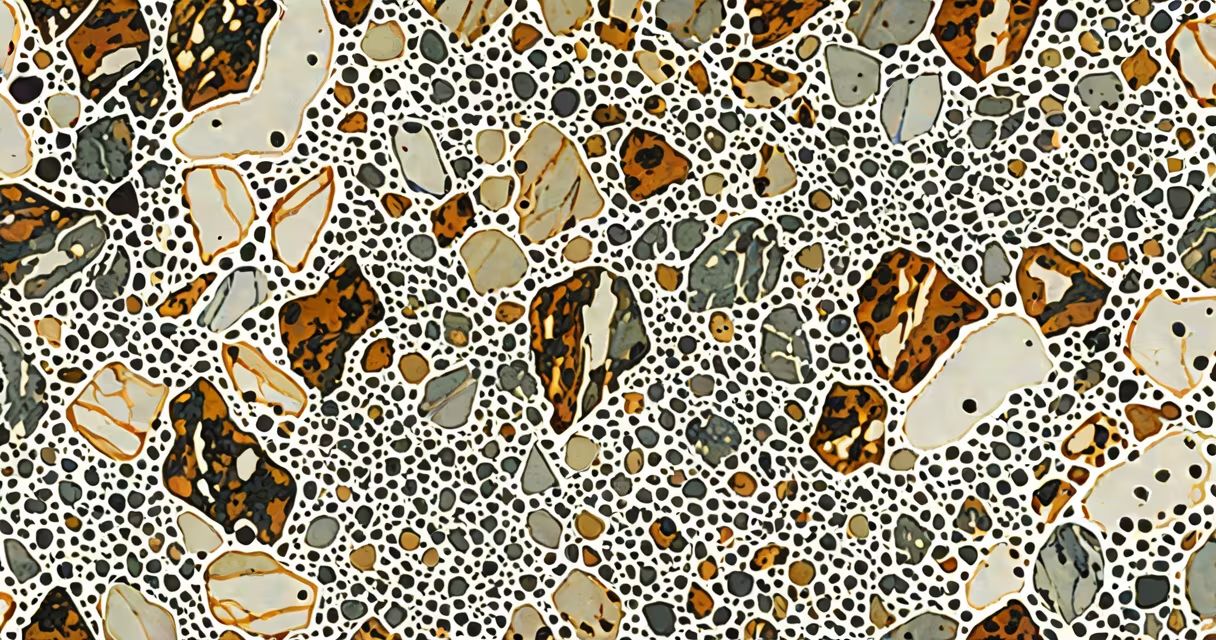
Granite is a coarse-grained, intrusive igneous rock primarily made of quartz (20-60%), feldspar (25-65%), and minor amounts of mica and other minerals. It forms slowly beneath Earth's surface from cooling magma, resulting in large interlocking crystals visible to the naked eye.
Geologists classify granite as a plutonic rock because it crystallizes at depth under high pressure and temperature. Its composition varies regionally, but the defining feature is a minimum of 20% quartz and 35-65% feldspar. The presence of alkali feldspar gives many granites a pink or red hue, while plagioclase feldspar produces gray tones.
Granite is not a single mineral-it's a rock type. This distinguishes it from materials like marble (a metamorphic rock) or quartzite (a recrystallized sandstone). Despite common usage, "granite" does not refer to any specific mineral; it describes a rock with a particular chemical and structural profile.
How Granite Forms
Granite originates when silica-rich magma cools slowly over thousands to millions of years beneath continental crust. The slow cooling allows atoms to arrange into large, stable crystal structures. This process occurs at depths between 15 and 30 kilometers, where temperatures range from 600°C to 800°C.
As the magma cools, quartz and feldspar crystallize first due to their higher melting points. Mica and amphibole form later. The final rock contains interlocking crystals with no preferred orientation-this texture is called granular or equigranular.
When tectonic forces uplift the crust, granite is exposed through erosion. Over time, weathering removes overlying rock, revealing granite outcrops such as those in the Sierra Nevada mountains or the Scottish Highlands. These exposures often appear as massive, rounded boulders or cliff faces.
Composition and Varieties
While all granite shares core components, variations arise from trace elements and mineral ratios. The most common types include:
| Type | Primary Minerals | Color Range | Common Locations |
|---|---|---|---|
| Alkali feldspar granite | Quartz, potassium feldspar, biotite | Pink, red, light gray | Sierra Nevada, California |
| Plagioclase granite | Quartz, plagioclase feldspar, hornblende | Gray, dark gray | Appalachian Mountains, USA |
| Biotite granite | Quartz, feldspar, biotite mica | Dark gray, black specks | Western Australia, Pilbara region |
Some granites contain rare minerals like zircon or tourmaline, which serve as geological indicators. For example, zircon crystals in granite can be dated using uranium-lead radiometric methods, providing age estimates accurate to within ±1 million years.
A key distinction often missed: granite is not always gray or white. The color depends on feldspar type and iron content. Red granite, such as the famous "Red Granite" from the Black Hills of South Dakota, contains iron-rich orthoclase feldspar that oxidizes during cooling.
Uses and Misconceptions
Granite's durability makes it ideal for construction, paving, and architectural features. It resists abrasion, thermal expansion, and chemical weathering better than most sedimentary rocks. The average compressive strength of granite ranges from 100 to 250 MPa-over twice that of typical concrete.
It's widely used in kitchen countertops, tombstones, and building facades. In the United States, granite accounts for about 15% of all natural stone used in residential interiors. The global market for granite slabs exceeded $12 billion in 2023, according to Statista.
Common confusion arises between granite and similar-looking stones. Quartzite, for example, appears similar but forms through metamorphism of sandstone. Unlike granite, quartzite is nearly pure quartz and fractures differently under stress. A simple scratch test with a steel knife reveals this: granite scratches glass but not metal, while quartzite can scratch both.
I once tested a countertop slab labeled "granite" that failed under impact. On inspection, it was actually a composite material with a thin granite veneer over engineered stone. The manufacturer had used the term loosely. This highlights a critical point: not all products marketed as "granite" are actual granite. Always verify with a geologist or lab analysis if authenticity matters.
Key Facts and Real-World Context
Granite forms over tens of thousands of years. The Bushveld Complex in South Africa, one of Earth's largest layered intrusions, contains granite-like rocks that cooled over 2 million years. This slow formation explains why granite has such consistent grain size and low porosity.
Despite its name, granite is not used in fireworks. The term "granite" comes from the Latin *granum*, meaning "grain," referring to its granular texture-not explosive properties. Fireworks use compounds like strontium carbonate (red) or barium chloride (green), not silicate rocks.
For context, the largest known granite outcrop is the Devil's Tower in Wyoming. It rises 386 meters above the surrounding plains and formed from a volcanic neck that cooled slowly. While not a typical granite exposure, it demonstrates how deeply buried igneous bodies can emerge through erosion.
Understanding how granite formed helps explain its role in shaping landscapes. The Sierra Nevada batholith, a massive granite massif, formed over 100 million years ago. Today, it supports ecosystems, provides groundwater recharge zones, and serves as a foundation for major rivers like the Merced and Tuolumne.
Granite is not just a building material-it's a record of Earth's internal dynamics. Its presence in mountain roots and continental cores reveals ancient crustal growth events. When you see a polished granite countertop, you're looking at a rock that spent millions of years forming deep underground before being exposed to sunlight.