
Simple bird drawing
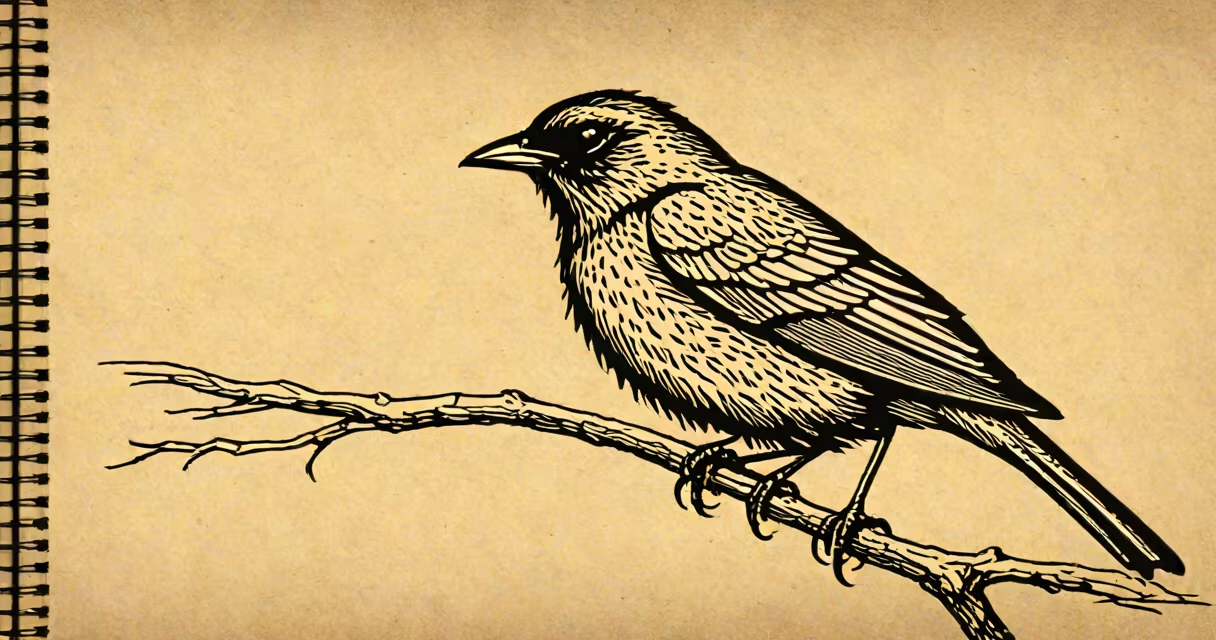
A simple bird drawing uses basic geometric shapes and few lines to represent a bird in a stylized, accessible way. It focuses on essential features-head, body, wings, tail-without detailed feathers or anatomy. This form is ideal for beginners, children, or anyone wanting quick results.
Simple bird drawings rely on abstraction. Instead of replicating a specific species, they use shapes like ovals for the body, circles for the head, and triangles for the beak. Lines define wings and tail. The entire process takes under five minutes and requires only a pencil and paper.
These drawings appear in children's books, classroom worksheets, and casual doodling. They're not meant to be realistic but to convey the idea of a bird and quickly. A single line can suggest flight, while a tilted posture implies movement.
How simple bird drawing works
The method builds on visual shorthand. Start with a circle for the head and a larger oval for the body. Connect them with a short neck line. Add a small triangle for the beak and a dot for the eye. Wings emerge as curved lines from the sides of the body, often shaped like half-moons. The tail is a tapered line or a small triangle at the back.
Positioning determines mood. A bird facing left suggests motion. A bird with wings raised appears to take off. A sideways tilt gives a playful look. These cues work because viewers recognize the pattern even in minimal form.
For example, a child drawing a bird with a large head, tiny eyes, and exaggerated wings is not making a mistake-it's using expressive simplification. This is common in early art development. According to the National Art Education Association, such drawings reflect cognitive growth in visual representation.
Types and variations
Simple bird drawings fall into three categories based on complexity and purpose:
| Type | Features | Use Case |
|---|---|---|
| Basic outline | Only essential lines-no shading, no texture | Teaching shapes, practicing hand-eye coordination |
| Stylized cartoon | Exaggerated features, facial expressions, changing poses | Storybooks, greeting cards, character design |
| Pattern-based | Repeats the same form across multiple birds, often in symmetry | Wallpaper, textile design, craft projects |
Pattern-based drawings are especially effective in group compositions. For instance, a row of five birds drawn with identical shapes and spacing creates rhythm. This technique is used in traditional Japanese woodblock prints, where repetition emphasizes harmony.
Many people confuse simple bird drawing with "stick figure" birds. Stick figures use only lines and lack closed shapes. A simple bird drawing always includes at least one enclosed form-like the body or head-to suggest volume and presence.
Where and why it's used
Simple bird drawings appear in educational materials for ages 4 to 8. They help children learn about animals without requiring fine motor control. A 2021 study by the American Psychological Association found that children who drew birds using basic shapes showed better retention of bird traits than those who copied photos.
In adult contexts, these drawings serve as placeholders. Artists use them in storyboards to block out scenes. Designers use them in wireframes for apps focused on nature or travel. A weather app might show a simple bird flying toward a sun icon to indicate fair conditions.
I once watched a student in a community art class struggle to draw a robin. After switching to a simple bird form-a circle head, oval body, wing arcs-they completed the piece in under ten minutes. The result wasn't accurate, but it captured the feeling of a bird in flight. That moment confirmed how much emotional expression can come from simplicity.
Common mistakes and corrections
Beginners often place the head too high on the body. This makes the bird look like it's tipping backward. To fix it, align the center of the head with the middle of the body. A slight downward tilt of the head adds realism.
Another error is drawing wings that extend past the body's width. Real birds have wings that curve inward. Use a gentle arc-not a straight line-to suggest folded or extended wings. The wing tip should not exceed the body's side edge.
Some assume the beak must be long and pointed. But many birds, like robins or sparrows, have short, rounded beaks. Use a small triangle with a blunt tip. The beak should not touch the eye.
One non-obvious detail: the eye placement affects perceived emotion. Eyes near the front of the head suggest alertness. Eyes farther back give a relaxed or sleepy look. This principle applies even in simplified forms.
Getting started: a worked example
To draw a simple bird in five steps:
- Draw a large oval for the body.
- Add a smaller circle above it for the head. Leave a small gap for the neck.
- Draw a small triangle pointing forward for the beak. Place a dot inside the head for the eye.
- Sketch two curved lines from the sides of the body-these are the wings. Keep them slightly below the body's center.
- Add a narrow triangle at the back for the tail. Draw a short line from the body's base for the legs.
After completing the lines, erase any overlapping marks. Darken the final outlines. You now have a complete simple bird drawing. This method works for any bird species-just adjust the proportions.
For practice, try drawing a sparrow (small body, short tail) versus a heron (long neck, thin legs). The same structure applies, but scaling changes the outcome.