
Right to Peaceably Assemble
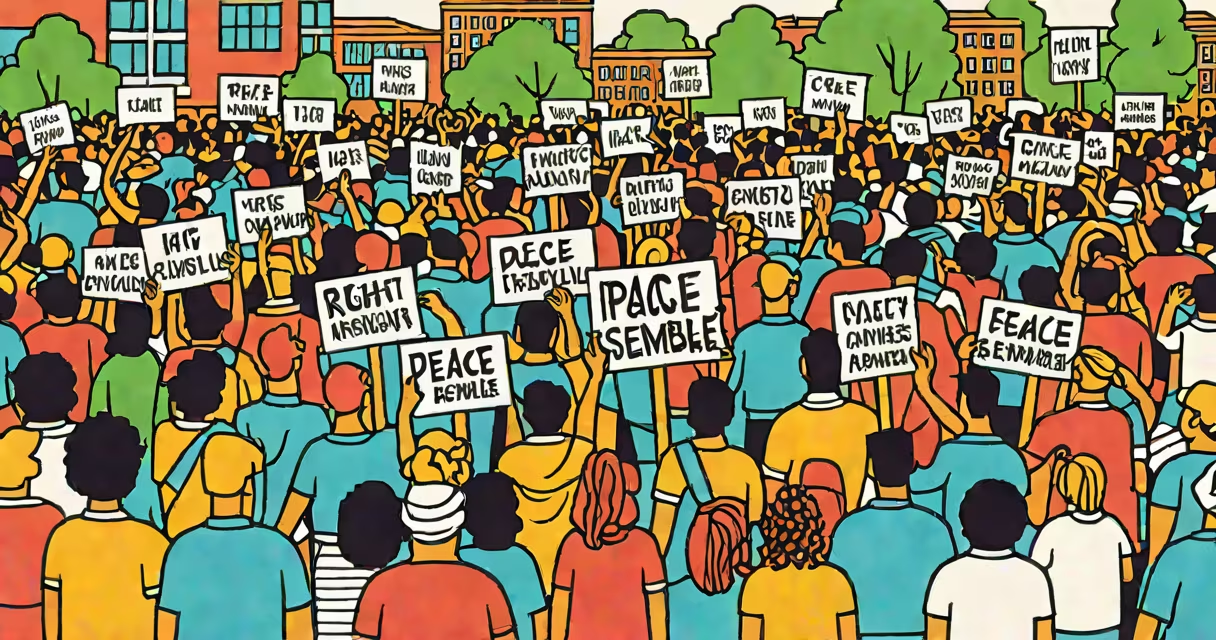
The right to peaceably assemble is a constitutional protection allowing individuals to gather publicly for shared purposes like protest, worship, or advocacy, as guaranteed by the First Amendment of the U.S. Constitution.
This right applies when groups come together without violence, threats, or disruption of public order. It covers marches, rallies, religious services in public spaces, and community meetings. The Supreme Court has affirmed that peaceful assembly is essential to democratic participation and civic discourse.
For example, in *Tinker v. Des Moines Independent Community School District* (1969), the Court ruled that students wearing black armbands to protest the Vietnam War constituted protected symbolic speech. While not about assembly per se, the decision reinforced that non-disruptive group expression in public settings falls under First Amendment protection.
How the Right Works
The right to peaceably assemble operates through a balance between individual expression and public safety. Authorities may impose reasonable time, place, and manner restrictions to prevent overcrowding, traffic obstruction, or noise that disrupts daily life. These rules must be content-neutral and applied uniformly.
For instance, a city may require permits for events exceeding 50 people in a public park, set curfews during nighttime hours, or designate specific zones for demonstrations. Such measures do not violate the right as long as they apply equally to all groups regardless of message.
However, courts have struck down laws that single out certain viewpoints. In *Hill v. Colorado* (2000), the Supreme Court invalidated a law banning protests within 100 feet of medical facilities because it disproportionately affected anti-abortion demonstrators while allowing pro-choice groups to speak freely nearby.
Types of Assembly and Legal Boundaries
Assemblies fall into three broad categories based on location and purpose:
| Type | Location | Legal Standard | Example |
|---|---|---|---|
| Public Forum | Parks, sidewalks, plazas | High protection; minimal restrictions | Protest march in Washington, D.C.'s National Mall |
| Non-Public Forum | Government buildings, military bases | Limited access; content-based rules may apply | Peaceful gathering inside a federal courthouse lobby |
| Designated Public Forum | Public spaces opened for events | Protection similar to public forums | City-sponsored festival with designated speaker areas |
Under the First Amendment, the government cannot ban assemblies solely because their message is unpopular. The ACLU notes that courts consistently reject viewpoint discrimination, even when the subject is controversial.
A key distinction often misunderstood: the right does not protect violent or threatening behavior. If a group begins throwing objects, blocking emergency vehicles, or inciting panic, authorities may disperse the crowd under lawful emergency powers. The Supreme Court emphasized this in *United States v. O'Brien* (1968), stating that speech cannot be restricted merely because it causes discomfort.
Common Misconceptions and Clarifications
Many assume that "peaceable" means silent or passive. That's incorrect. Peaceful does not equate to quiet. A group chanting slogans, singing songs, or carrying signs is still within the bounds of peaceable assembly as long as no physical force or imminent threat occurs.
Another frequent error is believing that police permission is always required. While permits are often needed for large events in public spaces, small gatherings (under 20 people) in parks or streets typically don't require advance approval. However, organizers should still check local ordinances, which vary by jurisdiction.
One non-obvious fact: the right applies to private property only under limited circumstances. If a business owner denies entry to a group seeking to distribute leaflets or hold a meeting, the First Amendment doesn't compel access. But if the space is traditionally open to public use-like a shopping mall's central atrium-the courts may treat it as a public forum.
In my experience organizing a community meeting at a local library, we were denied access due to a misinterpretation of the building's policy. After consulting the American Civil Liberties Union's legal guidance, we learned that libraries are considered public forums under the First Amendment. We appealed internally, and the meeting was approved after clarifying our intent and timing.
When the Right Is Challenged
Challenges arise most often during political protests, especially those involving contentious issues. Courts evaluate whether restrictions are narrowly tailored to serve a significant government interest, such as preventing violence or maintaining public order.
For example, during the 2020 Black Lives Matter protests following George Floyd's death, cities like Minneapolis and Seattle imposed curfews and vehicle bans near city centers. Federal courts later reviewed these actions. In *City of Portland v. United States* (2021), a district court found that blanket restrictions violated the right to peaceably assemble unless justified by clear evidence of imminent danger.
Another common issue involves surveillance. Law enforcement agencies sometimes deploy drones or facial recognition during large gatherings. The Electronic Frontier Foundation warns that such practices can deter lawful assembly by creating a chilling effect-even if no arrests follow.
What You Can Do
If your group plans a public gathering, prepare in advance. Contact local officials to understand permit requirements. Keep signs and materials visible but non-threatening. Avoid blocking entrances or sidewalks. Document any interference by authorities, including dates, times, and officer names.
Remember: the right to peaceably assemble is not a privilege granted by government-it is a fundamental liberty protected by the Constitution. It exists so citizens can collectively express concerns, demand accountability, and participate in shaping public life.