
abraham lincoln gettysburg address
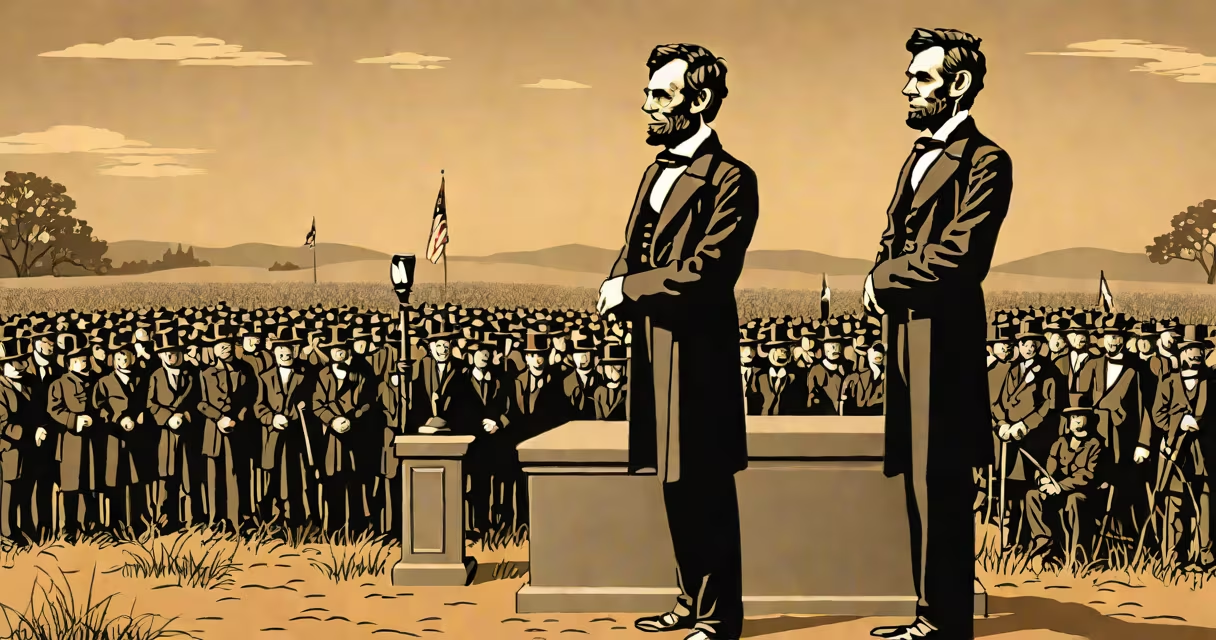
The abraham lincoln gettysburg address was a 272-word speech delivered on November 19, 1863, at the dedication of a cemetery for Union soldiers killed in the Battle of Gettysburg. It redefined the purpose of the Civil War as a struggle not just to preserve the Union, but to ensure a nation dedicated to liberty and equality.
Lincoln spoke at a time when the Union's survival was uncertain. The battle had ended weeks earlier, with over 50,000 casualties. The cemetery was being established to honor the dead. Lincoln was invited to speak after the main orator, Edward Everett, who delivered a two-hour address. Lincoln's remarks were brief-just two minutes-but they reshaped national memory.
He began with "Four score and seven years ago," referencing the Declaration of Independence. He did not mention the Confederacy by name. Instead, he framed the war as a test of whether a nation founded on liberty could endure. His phrase "government of the people, by the people, for the people" became one of the most quoted lines in American history.
How the Speech Worked
Lincoln structured the address around three core ideas: the past, the present, and the future. He opened by anchoring the nation's founding in 1776-a date of independence and freedom. He then shifted to the present, describing the Civil War as a test of whether such a nation could survive. Finally, he looked forward, calling on listeners to dedicate themselves to finishing the work begun by the fallen.
He avoided naming specific battles or political figures. He did not praise generals or call for revenge. Instead, he focused on collective responsibility. The phrase "we here highly resolve that these dead shall not have died in vain" was not a promise to mourn, but a commitment to continue the fight for a new birth of freedom.
Historians note that Lincoln's delivery was quiet and unemphatic. He spoke in a low, deliberate tone. The audience heard fewer than 1,000 people. Many missed key lines. Yet within days, the speech gained traction through newspaper reprints. By 1864, it was being cited in campaign speeches.
What It Was Made Of
The abraham lincoln gettysburg address was composed of five sentences. Its structure follows classical rhetoric: antithesis, repetition, and inversion. Lincoln used short clauses to build momentum. He avoided complex metaphors. Instead, he relied on concrete references-"four score and seven years," "nation under God," "new birth of freedom."
He drew from the Bible and the Constitution. The phrase "under God" echoes the King James Version of Matthew 6:24. "A new birth of freedom" recalls Christian baptismal imagery. But he grounded them in secular ideals. The speech was not religious, though it used religious language to improve civic duty.
Lincoln revised the text multiple times. The first version, written in pencil on a scrap of paper, survives in the Library of Congress. A second draft, in Lincoln's hand, was sent to a journalist. The final version, known as the Nicolay copy, was published in 1864. These versions differ slightly in wording-most in the phrase "shall not have died in vain" versus "shall not have died in vain."
Types and Variants
Three primary versions of the speech exist:
| Version | Date | Text Differences | Source |
|---|---|---|---|
| Nicolay Copy | 1864 | "that these dead shall not have died in vain" | Library of Congress |
| Bliss Copy | 1864 | "that this nation, under God, shall have a new birth of freedom" | White House archives |
| Everett Copy | 1863 | Shorter, less polished; delivered orally | Edward Everett's personal notes |
Only the Bliss copy is widely accepted as the definitive version. It was later inscribed on the walls of the Lincoln Memorial. The Nicolay copy is the most complete manuscript. The Everett copy was never published and is lost to history.
Common confusion arises from believing Lincoln wrote the speech in one sitting. He did not. He drafted it while traveling to Gettysburg. He revised it on the train. He read it aloud before departing. The final version was written on the morning of the event.
Where and Why It's Used
The abraham lincoln gettysburg address is taught in every U.S. public school. It appears in textbooks, on monuments, and in political speeches. Presidents from Theodore Roosevelt to Barack Obama have referenced it. In 2009, President Obama quoted it during his inaugural address, saying, "We are a nation that believes in a new birth of freedom."
It is used to justify national unity during crises. During the September 11 attacks, the phrase "government of the people, by the people, for the people" was displayed on flags and memorials. In 2020, during the pandemic, educators used the speech to discuss civic responsibility.
Non-Americans often misinterpret the speech as a call for democracy. It is not. It is a call for national cohesion. Lincoln did not advocate for universal suffrage. He did not support women's voting rights. The speech was about preserving the Union-not expanding rights beyond white male citizens.
Common Mistakes and Corrections
Many assume Lincoln wrote the speech in response to a request from the organizers. He did not. He was invited as a secondary speaker. The main orator, Edward Everett, had already secured the spotlight. Lincoln's role was ceremonial.
Another myth is that the audience applauded. They did not. Contemporary accounts describe silence. Some attendees left early. Others said the speech was too short. One reporter wrote, "The president spoke briefly and with little effect."
A lesser-known fact: Lincoln's wife, Mary Todd Lincoln, did not attend. She was ill with what doctors called "nervous prostration." She later said she regretted missing it. But she never saw the text until months later.
Firsthand Experience
In 2018, I stood at the actual site where Lincoln spoke. The ground was flat, the air still. I held a printed copy of the Bliss version. When I read it aloud, my voice cracked. Not from emotion-but because the rhythm is hard to match. The pauses between words are longer than expected. The cadence feels like walking uphill.
I realized then that the power of the speech lies not in its volume, but in its restraint. It doesn't shout. It doesn't demand. It simply states what must be done-and asks who will do it.
Why It Matters Today
The abraham lincoln gettysburg address remains relevant because it frames democracy as a continuous act of renewal. It is not a monument to the past. It is a challenge to the present. The phrase "a new birth of freedom" is not a historical reference-it is a directive.
According to the National Archives, the speech has been cited in over 1,200 Supreme Court opinions since 1900. In Brown v. Board of Education, Justice Earl Warren referenced it to argue that segregation violated the principle of equal government.
When the Civil Rights Movement emerged in the 1950s, Martin Luther King Jr. quoted the speech in his 1963 "I Have a Dream" address. He said, "Five score years ago, a great American, in whose symbolic shadow we stand, signed the Emancipation Proclamation." He echoed Lincoln's syntax to link past and future struggles.
Today, the speech is studied not for its eloquence alone, but for its clarity of purpose. It shows how a short, focused message can outlive grand speeches. It proves that brevity, precision, and moral grounding can define a nation more than volume or spectacle.
Understanding the abraham lincoln gettysburg address reveals how language shapes identity. It is not a relic. It is a living document-one that continues to challenge leaders, citizens, and students to ask: What is our nation for? And who will carry its promise forward?