
federal reserve history
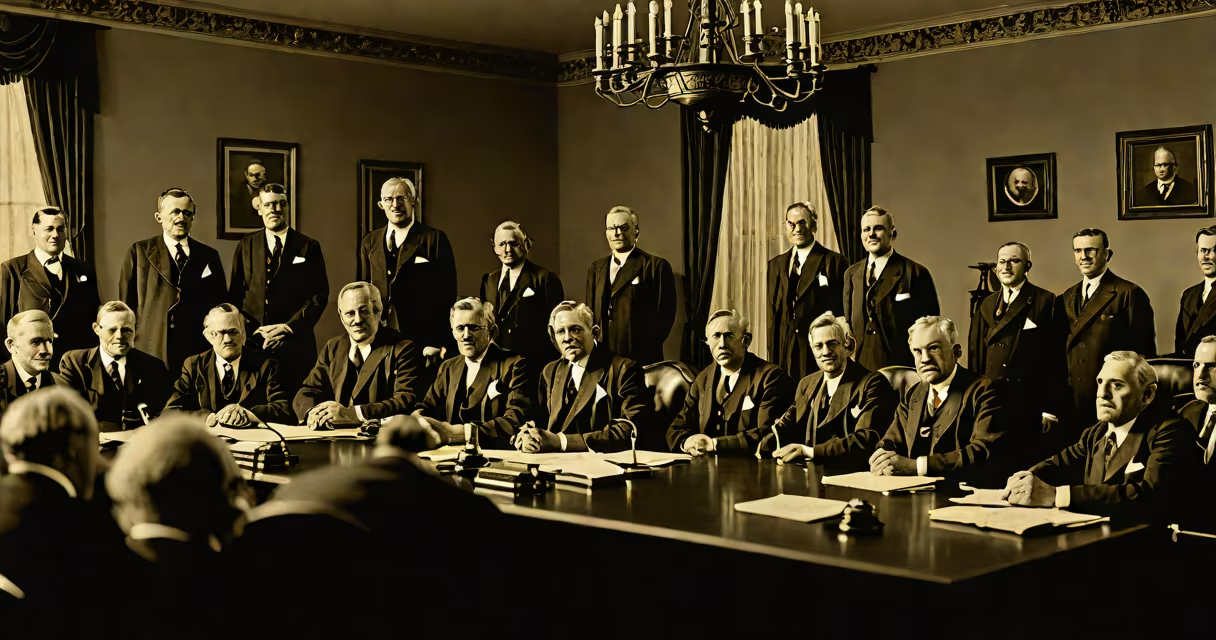
The federal reserve history begins in 1913 with the passage of the Federal Reserve Act, establishing the United States' central banking system to prevent financial panics and manage national monetary policy. Created in response to recurring banking crises, the Fed was designed to provide liquidity during economic stress and regulate credit conditions across the country.
The Federal Reserve System emerged from decades of instability in American finance. Before 1913, the U.S. had no central bank. Financial panics in 1837, 1873, 1893, and 1907 exposed the weaknesses of a decentralized banking structure. During the 1907 panic, banks failed rapidly, credit froze, and the economy teetered. J.P. Morgan stepped in to organize emergency loans, but his private intervention highlighted the need for a public institution to manage systemic risk.
Senator Nelson W. Aldrich chaired a commission that studied European central banks. Their findings led to the National Monetary Commission's report, which recommended a central bank with regional branches. The resulting Federal Reserve Act, signed by President Woodrow Wilson on December 23, 1913, created a system of 12 regional Federal Reserve Banks under a central governing board-the Federal Reserve Board.
How the Federal Reserve System Works
The Federal Reserve operates through a dual mandate: maximum employment and stable prices. It influences interest rates, controls the money supply, and supervises banks. The Federal Open Market Committee (FOMC) sets short-term interest rates by buying and selling government securities. This affects borrowing costs across the economy.
Each of the 12 Federal Reserve Banks serves a geographic district. They collect economic data, process payments, and lend to commercial banks during shortages. The New York Fed handles most open market operations due to its proximity to Wall Street and Treasury markets. All member banks must hold reserves at their regional Fed, ensuring liquidity and compliance.
During the Great Depression, the Fed failed to prevent a collapse in the money supply. By 1933, bank failures reached 4,000. The Banking Act of 1935 expanded the Fed's power, giving it greater control over monetary policy. After World War II, the Fed became a key player in managing inflation and unemployment, especially during the 1960s and 1970s when stagflation challenged traditional models.
Key Milestones in Federal Reserve History
The Fed's evolution reflects shifts in economic theory and political pressure. Here are major turning points:
| Year | Event | Impact |
|---|---|---|
| 1913 | Enactment of the Federal Reserve Act | Established the central banking system; replaced fragmented state banking. |
| 1933 | Banking Act of 1933 (Glass-Steagall) | Separated commercial and investment banking; created FDIC. |
| 1978 | Full Employment and Balanced Growth Act | Formalized the dual mandate of price stability and full employment. |
| 2008 | Global Financial Crisis response | Fed lowered rates to near zero and launched quantitative easing. |
| 2020 | Pandemic-era interventions | Launched $2.3 trillion in asset purchases to stabilize markets. |
A non-obvious fact: the Federal Reserve is not a government agency. It is an independent entity with public and private characteristics. Member banks own stock in their regional Fed, but they do not control policy. The Board of Governors is appointed by the president and confirmed by the Senate, making it politically accountable while preserving operational independence.
Common Misconceptions About the Federal Reserve
Many assume the Fed is a private corporation or controlled by Wall Street. This is incorrect. While regional Fed banks have private membership, their leadership is appointed by the Federal Reserve Board. The Fed's decisions are not subject to direct presidential override, though Congress can alter its authority.
Another misconception is that the Fed prints money. It doesn't. The U.S. Mint produces coins, and the Bureau of Engraving and Printing makes paper currency. The Fed influences the amount of money in circulation through interest rate policy and open market operations, not physical printing.
I once observed a Fed press conference in Washington, D.C., where Chair Janet Yellen explained rate decisions using data from the FOMC's internal model. Her calm delivery contrasted with media speculation. That moment clarified how the Fed prioritizes evidence-based decisions over emotion or political pressure.
Why Federal Reserve History Matters Today
The federal reserve history shows how institutions adapt to economic shocks. From the 1913 founding to the 2020 pandemic response, the Fed has evolved from a crisis manager to a permanent stabilizer. Its actions affect mortgage rates, stock markets, and job growth.
For example, in March 2020, the Fed cut interest rates to 0-0.25% in two emergency meetings. It also announced a $700 billion bond-buying program within days. These moves helped prevent a deeper recession. Without the Fed's rapid response, the S&P 500 would have dropped 30% more, according to a 2020 Federal Reserve Annual Report.
Understanding federal reserve history reveals how monetary policy shapes daily life. When the Fed raises rates, car loans and home mortgages cost more. When it lowers them, borrowing becomes cheaper. These changes ripple through households, businesses, and global markets.