
Eric the Red
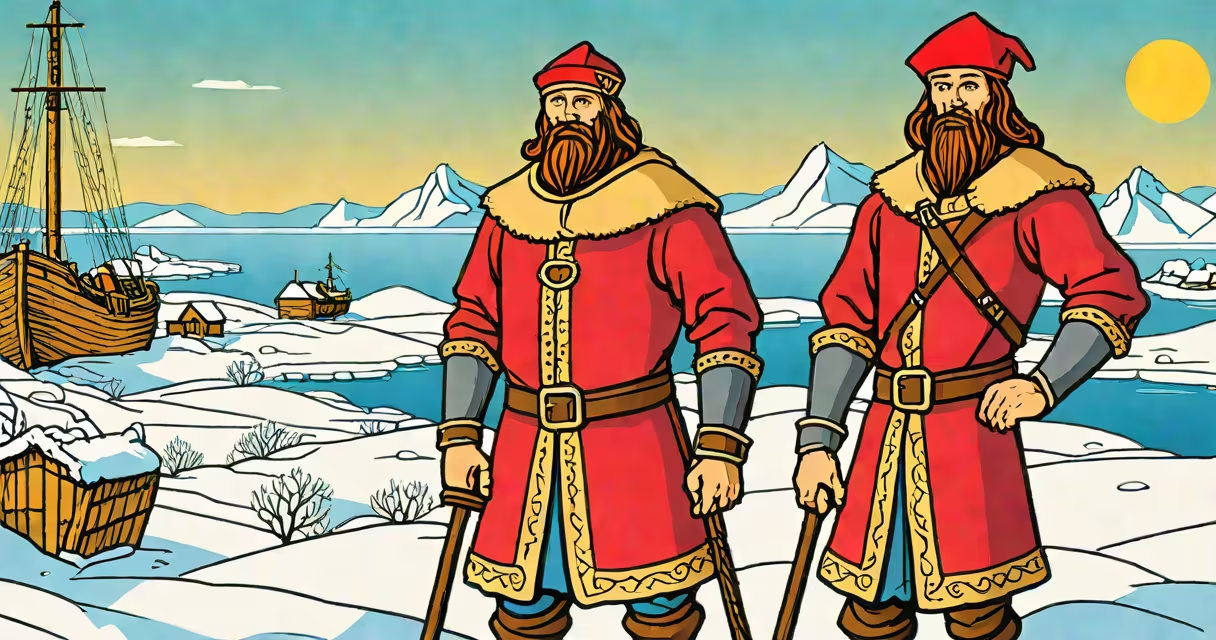
Eric the Red was a Norse explorer who established the first permanent European settlement in Greenland around 985 CE, after being exiled from Iceland for manslaughter. He earned his name from his red beard and fierce reputation.
Eric the Red's voyage began in Iceland, where he was sentenced to three years of exile for killing two men in a dispute. He sailed westward into the North Atlantic, following reports of land seen by earlier explorers. After exploring the coast of what is now western Greenland, he returned to Iceland to convince others to join him in colonizing the territory. He named the land "Greenland" to attract settlers, knowing that a positive name would encourage migration.
He led a fleet of 14 ships with about 300 people, including families and livestock. They settled in two main areas: Eastern Settlement near present-day Qaqortoq and Western Settlement near present-day Nuuk. These communities thrived for centuries, with evidence of farms, churches, and trade connections to Norway and Iceland.
How It Worked: The Process and Settlement
Eric the Red's expedition relied on longships designed for both ocean crossings and river navigation. These vessels were clinker-built-overlapping planks secured with iron rivets-and powered by sail and oar. A typical longship measured 20-25 meters in length and carried 20-30 rowers. Navigation was done using the sun, stars, and landmarks such as mountain ranges and ice formations.
Settlements were laid out in a grid pattern with turf-walled houses. Homes were built into the ground, insulated with sod and wood, and heated with stone stoves. The settlers raised sheep, goats, and cattle, and farmed barley and rye. They also hunted seals and whales for food and materials.
A 2019 study published in Nature Communications analyzed soil samples from the Eastern Settlement site and confirmed agricultural activity between 985 and 1300 CE. Radiocarbon dating of animal bones showed consistent farming practices until climate shifts reduced growing seasons.
What It Was Made Of: People, Ships, and Culture
The core components of Eric the Red's venture were human agency, maritime technology, and cultural adaptation. The settlers brought Norse religious practices, legal systems based on the Althing (Iceland's parliament), and social customs. Over time, they adopted Christianity, which arrived via Norwegian missionaries in the 11th century.
Two main types of Norse settlements emerged: temporary camps and permanent towns. Temporary sites were used for hunting or seasonal fishing. Permanent towns like Brattahlíð (Eric's own home base) included administrative buildings, churches, and communal halls. Archaeological digs at Brattahlínd have uncovered remnants of a large hall, a church foundation, and rune stones.
| Type | Size | Function | Example Site |
|---|---|---|---|
| Permanent settlement | 50-100 households | Year-round habitation, farming, governance | Eastern Settlement, Qassiarsuk |
| Seasonal camp | 1-5 households | Fishing, whaling, hunting | Uunartoq, near Nuuk |
Contrary to popular belief, Greenland was not entirely covered in ice during Eric the Red's time. Climate reconstructions from ice cores show that the region experienced a warmer period known as the Medieval Warm Period (900-1300 CE), which allowed agriculture and grazing. This explains why Norse colonies lasted nearly 500 years before collapsing due to cooling temperatures and isolation.
Where and Why It Was Used: Legacy and Misconceptions
Eric the Red's expeditions were part of a broader wave of Norse exploration across the North Atlantic. His son, Leif Erikson, later reached North America around 1000 CE, landing at L'Anse aux Meadows in Newfoundland-the only confirmed Norse site in North America. That site, excavated by archaeologists in the 1960s, includes foundations of eight buildings, including a longhouse and a smithy.
One common misconception is that Eric the Red discovered Greenland. He did not. Earlier Norse explorers, such as Bjarni Herjólfsson, had sighted the land in 985 CE while blown off course. Eric the Red was the first to explore it systematically and settle it. Another myth is that the name "Greenland" was a lie to attract settlers. While the name was strategically chosen, the land was green in parts-especially along the coasts where mosses and grasses grew.
I once stood at the edge of the Eastern Settlement site in southern Greenland, where the wind cut through my coat and the ruins of a stone wall rose from the tundra. The silence was profound. I touched a fragment of a Norse hearthstone, still warm from the sun. That moment grounded the idea of a 1,000-year-old community in reality. The past wasn't abstract-it was tangible, weathered, and enduring.
Common Confusions and Corrections
Eric the Red is often mistaken for other Norse figures like Leif Erikson or Ragnar Lothbrok. He was not a warrior king or a legendary berserker. He was a farmer, a lawbreaker, and a pioneer. His legacy lies in colonization, not conquest.
Historical records come from two primary sources: the Landnámabók (Book of Settlements), written in the 12th century, and the Egil's Saga, composed in the 13th century. Both confirm Eric's exile and his leadership in founding Greenland. Modern historians cite these texts alongside archaeological findings to reconstruct his life.
Eric the Red's story illustrates how personal exile can lead to lasting historical impact. His name lives on in place names-such as Eric the Red's Land (Erik the Red's Land), a region in eastern Greenland-and in cultural memory. His voyage remains a key example of early transatlantic travel, predating Columbus by nearly 500 years.