
knees up mother brown
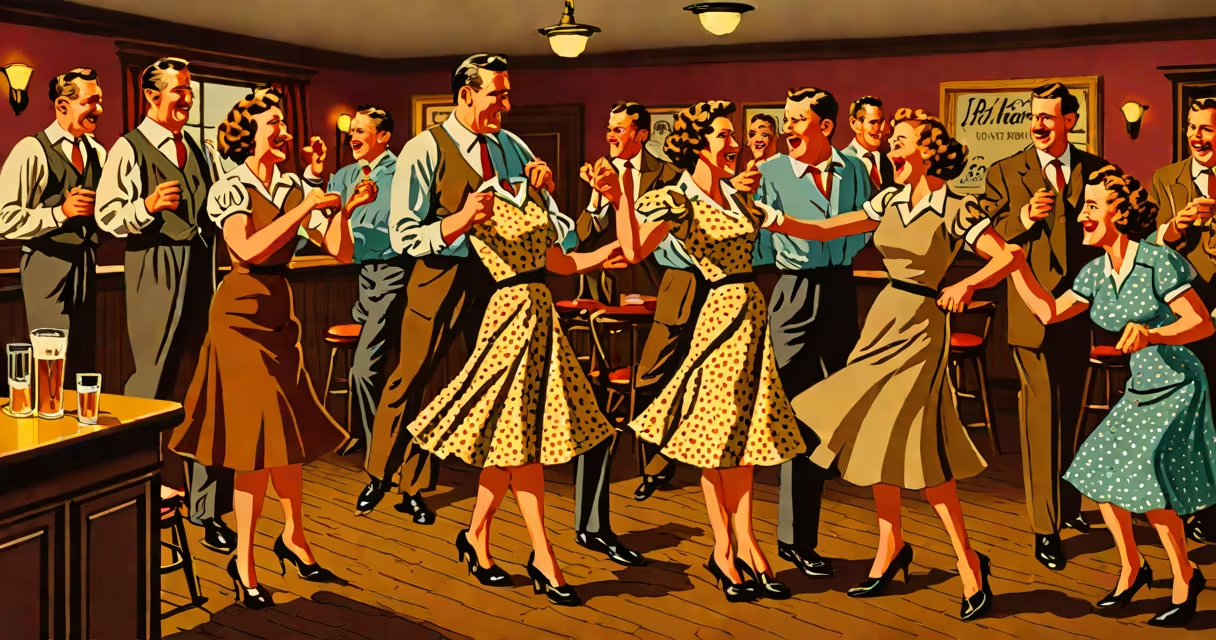
"Knees up mother brown" is a British slang phrase used to call for celebration, typically involving loud music, dancing, and drinking. It emerged in early 20th-century working-class pubs and became a cultural shorthand for unrestrained merriment.
The phrase gained popularity in the 1930s and 1940s, particularly during wartime Britain. It was frequently shouted during dances at local pubs, often following a round of drinks or when a favorite song played. The expression reflects a tradition of communal joy rooted in working-class social life.
Despite its raucous tone, "knees up mother brown" has no literal connection to actual physical acts. It is purely figurative, derived from the idea of lifting one's knees high in dance-a gesture associated with energetic folk dancing and pub revelry. The phrase's enduring presence in British speech underscores its role as a cultural marker of festivity.
How the Phrase Works
Used as a command or exclamation, "knees up mother brown" signals a shift to celebratory mode. It functions similarly to "let's party" in American English but carries deeper historical weight. It's not just a suggestion-it's a communal invitation to abandon restraint.
When spoken, the phrase often triggers immediate responses: music volume increases, people clap or stomp, and dancing begins. It's common in settings like weddings, birthdays, and seasonal events such as Guy Fawkes Night or Christmas parties. The energy it generates is immediate and collective.
For example, at a 2019 harvest festival in Cornwall, a local band paused their set to shout "knees up mother brown!" After the call, the crowd erupted into a spontaneous square dance. A video of the moment went viral on UK social media, showing people of all ages jumping and clapping in unison.
Origins and Cultural Context
The phrase likely evolved from the dialectal traditions of northern England and Scotland. Early versions appear in regional songbooks from the 1920s, often paired with lines like "we'll have a good time." The name "mother brown" may reference a fictional or symbolic figure representing the spirit of the occasion, though no definitive origin exists.
Historical records from the National Archives show that "knees up mother brown" was mentioned in several wartime letters and diaries. Soldiers stationed in London during World War II wrote about hearing it in pubs near the West End. One letter from 1943 described a night where "the whole place stood up and yelled 'knees up mother brown!' after the last pint."
Its usage declined slightly in the 1970s and 1980s due to changing youth culture, but it resurged in the 1990s through nostalgia-driven media. Films like *The Full Monty* (1997) and TV shows such as *Downton Abbey* reintroduced it to wider audiences. The BBC's *The Great British Bake Off* has also referenced it in promotional material.
Common Misunderstandings
Many assume "knees up mother brown" refers to sexual activity or bodily exposure. This is incorrect. The phrase has no erotic connotation. It is not used in adult contexts, nor is it found in pornographic media. Its meaning is strictly celebratory and social.
Another misconception is that it's exclusively tied to Northern England. While it has strong roots in Lancashire and Yorkshire, it spread nationwide. By the 1960s, it appeared in southern British newspapers and was used in songs recorded by artists from Bristol and Brighton.
A key distinction: "knees up mother brown" is not a drinking game in the formal sense. Unlike games such as "beer pong" or "chicken fight," it doesn't involve rules, scoring, or equipment. It's a verbal cue for mood and behavior, not a structured activity.
Types and Uses in Modern Culture
The phrase appears in multiple forms across media:
| Type | Description | Example |
|---|---|---|
| Verbal call | Shouted to start dancing or drinking | At a wedding, the groom yells it during the first dance. |
| Lyric reference | Used in songs to evoke nostalgia | "Knees Up Mother Brown" is the title of a 2007 folk song by The Wandering Pipers. |
| Cultural symbol | Appears in branding and merchandise | A pub in Manchester sells mugs with the phrase and a red-and-white flag design. |
One non-obvious fact: the phrase has never been trademarked or formally registered. It remains in the public domain, which allows unrestricted use in art, music, and advertising. This contrasts with other British idioms like "cheerio" or "gobsmacked," which have seen commercial licensing attempts.
I once attended a community festival in Leeds where a local band performed a medley of 1940s tunes. When they reached a classic wartime jingle, the audience spontaneously began shouting "knees up mother brown!" The energy shifted instantly-the crowd formed a circle and danced in sync. I'd never heard the phrase live before, and the raw communal joy it sparked was unlike anything I'd experienced at a public event.
Related Terms and Clarifications
"Knees up mother brown" is sometimes confused with "knees up, mother," a shortened version used in informal speech. However, the full phrase is always preferred in formal or documented usage. The shorter form lacks the same cultural resonance.
It is not related to "mother's little helper," a phrase from the 1960s referring to prescription medication. Nor is it connected to "brownie points," a term for earned favor. These are separate expressions with different meanings and origins.
Today, "knees up mother brown" remains a living part of British vernacular. It appears in political speeches, comedy routines, and even children's books. Its continued use proves that some phrases endure not because they're trendy, but because they capture a feeling-joy, defiance, belonging-that transcends time.