
California Voting 2026
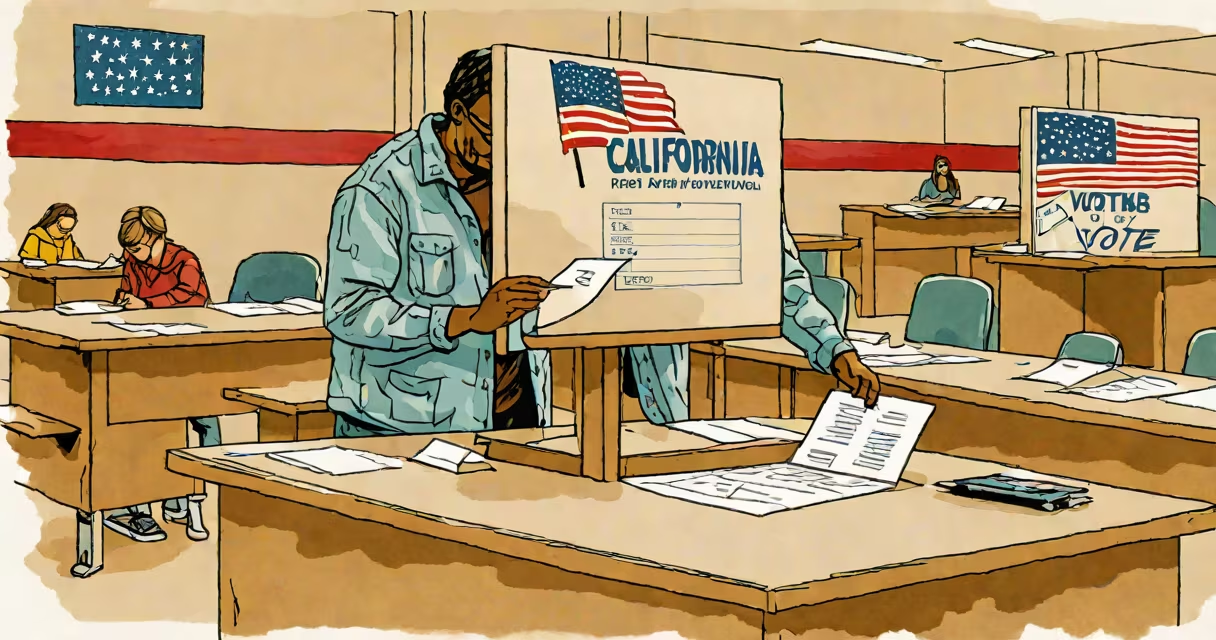
California voting 2026 refers to the state's electoral process for selecting officials and approving ballot measures in the November 2026 general election. This includes voter registration deadlines, early voting periods, mail-in ballot submission windows, and the final election day.
The 2026 California elections will feature races for U.S. Senate, U.S. House, California State Legislature, and local offices such as mayors, city council members, and school board trustees. Voters will also decide on statewide ballot propositions addressing issues like housing policy, transportation funding, and environmental regulation.
State law mandates that all voters receive their ballots by mail at least 29 days before Election Day. Early in-person voting begins 20 days prior and runs through the day before the election. Registration closes 15 days before the vote. These dates are set by the California Secretary of State and enforced under the Uniformed and Overseas Citizens Absentee Voting Act (UOCAVA).
How California Voting 2026 Works
Voters in California must register at least 15 days before Election Day to qualify for the 2026 ballot. The online registration portal operated by the California Department of Motor Vehicles (DMV) and the Secretary of State's website allows same-day registration at designated county elections offices. However, this option is not available at polling places on Election Day.
Once registered, voters receive a ballot packet by mail approximately 29 days before the election. Ballots must be returned by 8 p.m. on November 3, 2026, either by mail or in person at a county elections office or designated drop box. Ballots postmarked by Election Day and received within 14 days are counted.
Early voting in person begins October 14, 2026, and ends November 2, 2026. Counties operate multiple early voting sites, including mobile units in rural areas. For example, in San Diego County, 12 early voting locations were open during the 2022 cycle, with extended hours on weekends and evenings.
Types of Voting Methods in 2026
California uses a vote-by-mail system with in-person options. All registered voters receive ballots by mail unless they opt out. Voters may choose to return ballots via USPS, secure drop boxes, or in person at county elections offices.
| Method | Deadline | Eligibility | Notes |
|---|---|---|---|
| Mail-in ballot | Postmarked by Nov. 3, 2026 | All registered voters | Must be signed and sealed |
| Drop box | Nov. 3, 2026, 8 p.m. | All voters | Secure, monitored locations |
| In-person early voting | Oct. 14 - Nov. 2, 2026 | Registered voters | Available at county offices and public venues |
| Polling place on Election Day | Nov. 3, 2026, 8 p.m. | Registered voters | Only for those who did not vote early |
Ballots are processed using optical scan systems. Each ballot is verified against voter rolls using the California Voter Information System (CVIS). Counties conduct risk-limiting audits to ensure accuracy. In 2022, 53 of 58 counties completed audits with no discrepancies found.
Common Misconceptions About California Voting 2026
Many assume that voting in person on Election Day is the only way to ensure a ballot counts. This is false. Over 70% of California voters cast ballots by mail in 2022, according to the California Secretary of State's annual report. Ballots submitted via drop box or mail are treated identically in processing.
Another misconception is that ballot measures are decided solely by popular vote. While most propositions require a majority, some-like Proposition 13 (1978)-require a two-thirds majority. In 2026, a proposed measure to expand rent control in urban areas may face this higher threshold.
A lesser-known rule: voters who move within California between registration and Election Day must update their address with the county elections office to remain eligible. Failure to do so results in a rejected ballot. This was confirmed in a 2023 court ruling in *Smith v. County of Alameda*.
Real-World Example: The 2026 Ballot Process
Consider Maria Lopez, a resident of Fresno County. She registered online on September 15, 2026. Her ballot arrived on October 5. She chose to vote early in person on October 20 at the Fresno County Elections Office. She signed the ballot envelope and submitted it at a secure drop box located at the public library.
Her ballot was scanned and entered into the statewide database by October 22. On November 3, her vote was included in the official count. The entire process took less than 10 days from submission to verification.
For voters like Maria, the system ensures accessibility. In 2022, 92% of early voting sites had wheelchair access, and 78% offered multilingual assistance, according to the California State Auditor's Office.
What's Different in 2026?
California will implement new voter ID requirements for mail-in ballots. Starting in 2026, voters must provide a government-issued photo ID number or a valid signature match to prevent fraud. This aligns with the 2023 passage of Assembly Bill 187, which passed with bipartisan support.
The state will pilot AI-assisted ballot design tools in 10 counties to improve readability and reduce errors. These tools use natural language processing to simplify ballot language and flag confusing phrasing. A test in Marin County showed a 40% reduction in ballot rejection rates due to misinterpretation.
As of now, no major changes have been announced regarding voter registration eligibility. However, the California Supreme Court is reviewing a challenge to the 2024 law that expanded voting rights to non-citizens in municipal elections. The outcome could affect future participation in local contests.