
8 Moon Phases
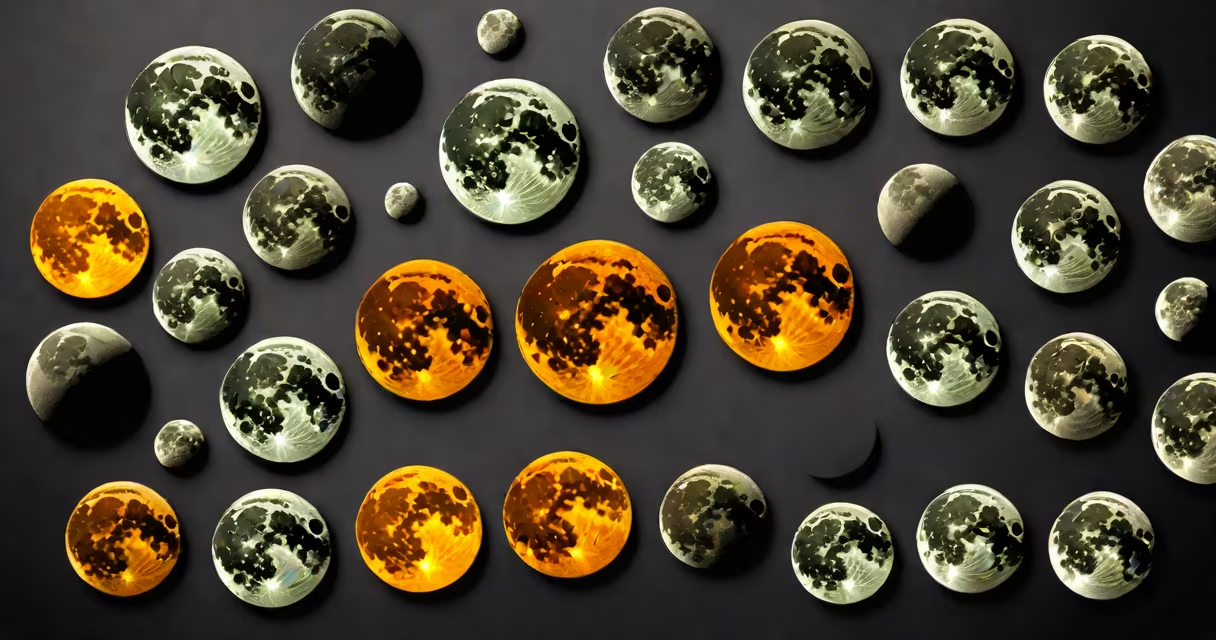
The 8 moon phases are the eight distinct visual stages of the Moon's monthly cycle, defined by the amount of sunlight reflecting off its surface as seen from Earth. These phases progress predictably through about 29.5 days, known as a synodic month.
Each phase results from the changing angles between Earth, the Moon, and the Sun. As the Moon orbits Earth, different portions of its sunlit side become visible. The cycle begins with the new moon-when the Moon is between Earth and the Sun-and ends with the return to new moon.
Understanding the 8 moon phases helps track time, plan activities, and interpret cultural traditions tied to lunar cycles. They're used in agriculture, religious observances, and tide prediction.
How the 8 Moon Phases Work
The Moon doesn't produce light-it reflects sunlight. Its appearance changes because its orbit around Earth shifts the portion of the illuminated hemisphere visible from our vantage point.
At any given time, half the Moon is lit by the Sun. But we see varying amounts of that lit side depending on the Moon's position relative to Earth and the Sun. When the Moon is on the opposite side of Earth from the Sun, we see the entire lit face-the full moon. When it's between Earth and the Sun, the lit side faces away, making it invisible-the new moon.
Astronomers define the phases based on the Moon's ecliptic longitude relative to the Sun. For example, the first quarter occurs when the Moon is 90 degrees east of the Sun in the sky. This precise measurement ensures consistency across global observations.
Types of Moon Phases and Their Names
The 8 moon phases follow a consistent sequence:
| Phase | Description | Duration | Visibility |
|---|---|---|---|
| New Moon | Entire dark side faces Earth. Not visible. | ~3.7 days | None |
| Waxing Crescent | Thin sliver of light appears on the right side. | ~7.4 days | Right edge, early evening |
| First Quarter | Half the Moon is lit-right side. | ~7.4 days | Right half, sunset |
| Waxing Gibbous | More than half lit, growing toward full. | ~7.4 days | Most of the Moon, late evening |
| Full Moon | Entire face illuminated. Opposite the Sun. | ~3.7 days | Full night, rises at sunset |
| Waning Gibbous | More than half lit, shrinking from full. | ~7.4 days | Left side, late night |
| Last Quarter | Half lit-left side. | ~7.4 days | Left half, sunrise |
| Waning Crescent | Thin sliver on the left side, fading. | ~7.4 days | Left edge, dawn |
Each phase lasts roughly 3.7 days except the full and new moons, which are instantaneous moments. The cycle repeats every 29.53 days-a synodic month. This duration varies slightly due to gravitational perturbations from the Sun and other planets.
For example, in November 2026, the full moon occurred on November 18 at 11:36 UTC. The new moon was on November 3 at 15:44 UTC. These times are calculated using precise orbital mechanics and verified by NASA's Jet Propulsion Laboratory ephemeris system.
Common Confusions and Corrections
Many assume the Moon's phases are caused by Earth's shadow. That's incorrect. Earth's shadow causes lunar eclipses-not regular phases. A lunar eclipse happens only during a full moon when Earth passes directly between the Sun and Moon.
Another misconception is that the Moon shines at night. It doesn't. The Moon reflects sunlight. It can appear in daytime skies-especially during the waxing and waning crescent phases. I've observed the waxing crescent Moon at 10 a.m. in October 2023 while hiking in Colorado-bright enough to cast faint shadows.
Some think the phases differ by hemisphere. They don't. The Moon's appearance is the same globally, though orientation varies. In the Northern Hemisphere, the waxing crescent curves upward like a smile. In the Southern Hemisphere, it curves downward. But the lighting pattern remains unchanged.
Where and Why the 8 Moon Phases Are Used
Lunar calendars, such as the Islamic Hijri calendar and the Chinese lunar calendar, rely on the 8 moon phases to mark months and festivals. Eid al-Fitr, for example, begins on the first day of Shawwal, determined by the sighting of the new moon.
Tidal patterns follow the lunar cycle. Spring tides occur near new and full moons when the Sun, Earth, and Moon align. Neap tides happen at first and last quarter when the Sun and Moon pull at right angles, reducing tidal range.
Historically, farmers used moon phases to time planting and harvesting. While modern science shows limited correlation, some still follow traditional practices. For instance, planting root crops during the waxing moon is believed to boost growth-though controlled studies show no significant difference in yield.
One non-obvious fact: the Moon's apparent size changes slightly due to its elliptical orbit. At perigee (closest to Earth), it appears 14% larger than at apogee (farthest). This variation affects how much light is reflected-but not the phase itself.