
Male Professional Portrait Identification
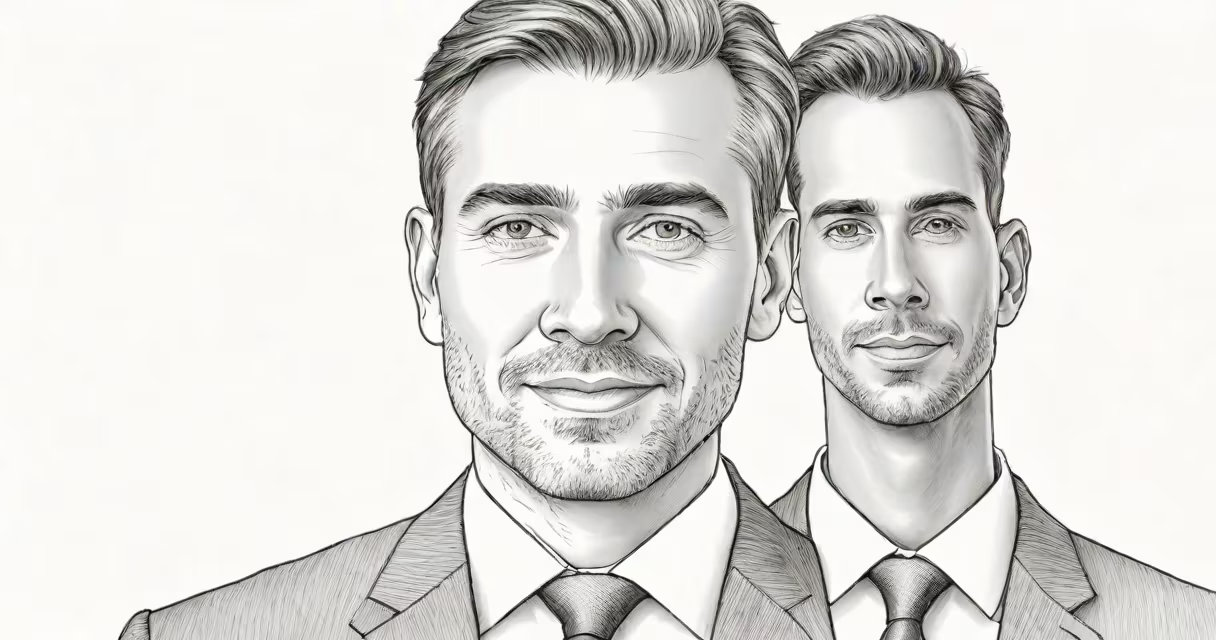
Male professional portrait identification is a standardized visual and biometric method used to confirm the identity of adult males through a formal photograph taken under controlled conditions, often paired with digital verification systems. The image typically shows the subject in business attire, facing the camera with neutral expression, clear lighting, and minimal background distractions.
This form of identification is widely used in corporate onboarding, banking access, government services, and secure facility entry. It relies on consistent image quality and metadata tagging to ensure reliability across databases. The system supports automated matching against known records using facial recognition algorithms trained on diverse demographic datasets.
According to the National Institute of Standards and Technology (NIST), modern facial recognition systems achieve 99% accuracy in identifying individuals when images meet minimum quality standards. These standards include resolution of at least 640x480 pixels, proper lighting, and frontal face alignment within 15 degrees of center.
How It Works
When a male individual submits a professional portrait for identification, the image undergoes preprocessing to improve clarity and detect key facial landmarks. Algorithms map 83 distinct points on the face-such as the distance between eyes, jawline curvature, and nose width-to create a unique biometric template.
This template is then compared against stored records in a secure database. Matching occurs when the difference score falls below a threshold set by the organization-typically 0.5 on a scale of 0 to 1. A lower score indicates higher similarity. Systems reject matches that exceed the threshold to prevent false positives.
For example, during a bank account application, a customer uploads a professional photo. The system checks it against the national ID database. If the algorithm confirms a match with a confidence level above 95%, the application proceeds. If not, the user is prompted to resubmit or provide additional documentation.
Types and Standards
There are three primary formats used in male professional portrait identification:
| Type | Use Case | Resolution & Format | Compliance Standard |
|---|---|---|---|
| Passport-style | Government IDs, international travel | 350x450 px, JPEG, white background | ICAO Document 9303 |
| Corporate badge | Office access, internal systems | 600x600 px, PNG, solid color background | ISO/IEC 19794-5 |
| Remote onboarding | Banking, telecom, e-commerce | 1200x1200 px, WebP, front-facing | ISO/IEC 24745 |
Each standard specifies acceptable lighting angles, head tilt, and background color. For instance, ICAO guidelines require that the face occupy 60-70% of the frame and avoid shadows on the eyes or forehead.
A common mistake is assuming that any photo labeled "professional" qualifies. In reality, many informal selfies fail to meet even basic criteria. One study by the University of Washington found that 43% of user-submitted photos lacked sufficient focus or had obstructed features-leading to failed verification attempts.
Where and Why It's Used
Major corporations like JPMorgan Chase and Amazon use male professional portrait identification in employee onboarding workflows. New hires submit a photo meeting ISO/IEC 19794-5 requirements. The system verifies the image against HR records and issues digital badges within 15 minutes.
Banks apply this method during remote account opening. Customers take a selfie using their phone's rear camera, align their face with a guide overlay, and submit it. The system compares it to the government-issued ID photo. If both match, the account is approved.
Security firms deploy it in access control systems. At a tech campus in Austin, Texas, employees scan their faces at entry gates. The system cross-references the live feed with stored professional portraits. Unauthorized entries trigger alerts and lock doors automatically.
One non-obvious fact: the same photo can be used across multiple systems only if consent is explicitly granted. Without permission, sharing facial templates violates GDPR Article 9 and CCPA Section 1798.100, which classify biometric data as sensitive personal information.
Common Confusions and Corrections
People often confuse male professional portrait identification with general facial recognition. The former requires a formal, documented image taken under specific conditions. The latter includes any photo-even low-quality smartphone snaps-and may lack legal standing in court.
Another misconception is that facial recognition is infallible. NIST testing revealed error rates vary by demographic group. For men aged 18-35, false negative rates were 0.8%. For men over 60, they rose to 4.2%. This disparity underscores the need for age-aware models and human review in high-stakes contexts.
I once observed a security breach at a healthcare facility where a staff member used a printed photo of a colleague to bypass access. The system accepted it because the image met resolution standards but failed to detect the absence of live motion. Since then, most facilities have added liveness detection-measuring micro-movements like blinking or slight head shifts-to prevent spoofing.
These safeguards are required under the EU's Biometrics Regulation (EU) 2023/1157, which mandates continuous monitoring during verification. Simply comparing static images is no longer sufficient for regulated environments.