
What is hemoglobin in the blood
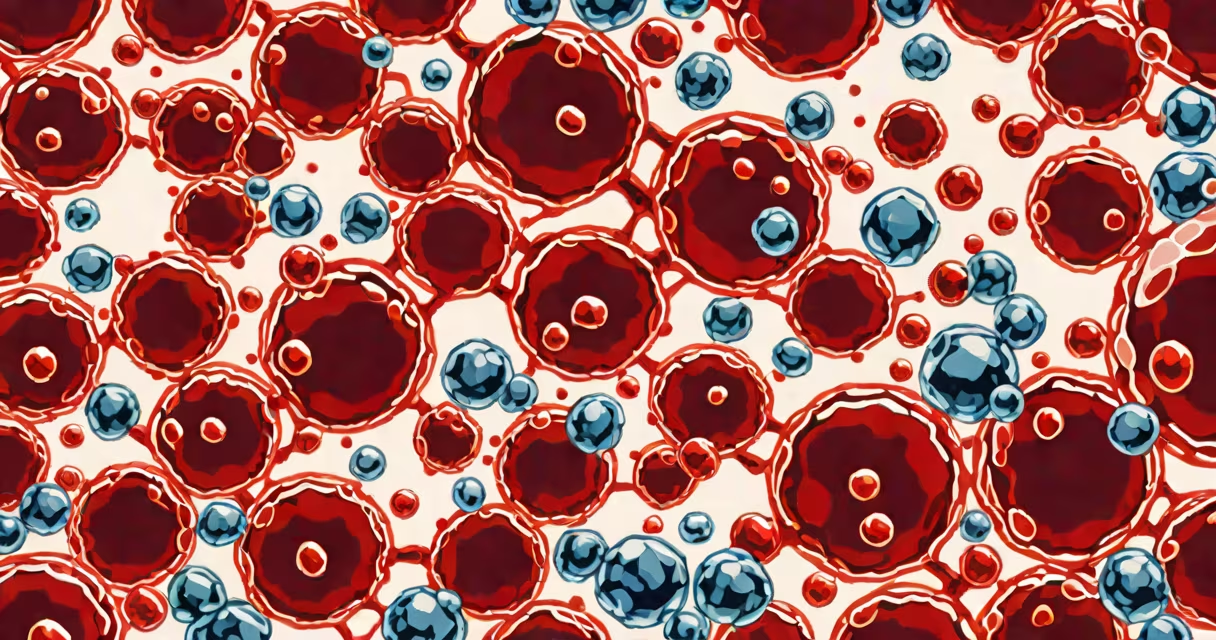
Hemoglobin is a protein in red blood cells that binds oxygen in the lungs and releases it to tissues throughout the body. Each molecule contains four iron atoms, which attach to oxygen molecules, enabling efficient oxygen transport.
Red blood cells circulate through arteries and capillaries, delivering oxygen to organs and muscles. Hemoglobin's ability to bind and release oxygen depends on local oxygen concentration, pH, and carbon dioxide levels. When oxygen levels drop in tissues, hemoglobin releases oxygen to meet metabolic demand.
The average adult has about 15 grams of hemoglobin per deciliter of blood. Levels below 13 g/dL in men or 12 g/dL in women suggest anemia. Normal ranges vary slightly between labs, but values consistently low across multiple tests require medical evaluation.
How hemoglobin works in the bloodstream
Hemoglobin functions through a reversible binding process. In the lungs, where oxygen pressure is high, hemoglobin binds four oxygen molecules-one per heme group. This forms oxyhemoglobin, which appears bright red and gives arterial blood its color.
As blood moves into tissues, oxygen pressure drops. Hemoglobin releases oxygen to cells, shifting to deoxyhemoglobin, which is darker red. This shift occurs due to changes in pH and carbon dioxide buildup-known as the Bohr effect. Carbon dioxide also binds to hemoglobin, forming carbaminohemoglobin, aiding in carbon dioxide transport back to the lungs.
A single hemoglobin molecule can carry four oxygen molecules. With roughly 250 million hemoglobin molecules per red blood cell, and 25 trillion red blood cells in an average human, the total oxygen-carrying capacity exceeds 100 billion oxygen molecules per second during peak activity.
Structure and composition of hemoglobin
Hemoglobin consists of four polypeptide chains: two alpha and two beta chains in adults (designated α₂β₂). Each chain wraps around a heme group, a ring-like structure containing a central iron ion. The iron ion binds one oxygen molecule, making each hemoglobin molecule capable of carrying four oxygen molecules simultaneously.
Iron is essential-without it, hemoglobin cannot bind oxygen. A deficiency in dietary iron leads to reduced hemoglobin production, causing iron-deficiency anemia. Symptoms include fatigue, pale skin, and shortness of breath during exertion.
Abnormal hemoglobin variants exist. Sickle cell hemoglobin (HbS) results from a mutation in the beta-globin gene. A single amino acid substitution (glutamic acid to valine) causes hemoglobin to polymerize under low oxygen, distorting red blood cells into crescent shapes. These cells block small vessels, leading to pain crises and organ damage. According to the CDC, sickle cell disease affects about 1 in 365 Black or African American births in the U.S.
Types and clinical significance
Several hemoglobin types exist, categorized by their chain composition:
| Type | Chain Composition | Normal Range | Clinical Relevance |
|---|---|---|---|
| Hemoglobin A | α₂β₂ | 95-98% | Primary oxygen carrier in adults |
| Hemoglobin A2 | α₂δ₂ | 1.5-3.5% | Elevated in beta-thalassemia carriers |
| Hemoglobin F | α₂γ₂ | 0-1.5% | Predominant in fetuses; persists in some genetic disorders |
| Sickle hemoglobin (HbS) | α₂β₂ with mutation | Not normally present | Causes sickle cell disease when inherited from both parents |
Testing hemoglobin levels is routine in blood work. A complete blood count (CBC) includes hemoglobin measurement. Values below 13 g/dL in men or 12 g/dL in women trigger further investigation. Causes include blood loss, chronic disease, kidney failure, or nutritional deficiencies.
One non-obvious fact: hemoglobin does not function independently. It relies on red blood cell integrity. Damage to the cell membrane-such as from oxidative stress or mechanical trauma-reduces hemoglobin efficiency even if the protein itself is normal. This explains why conditions like hemolytic anemia cause symptoms despite normal hemoglobin structure.
Common misunderstandings and clarifications
Hemoglobin is often confused with hematocrit. While both relate to red blood cells, hematocrit measures the volume percentage of red cells in blood (typically 40-50% in men, 36-44% in women). Hemoglobin measures the actual protein concentration. A person can have normal hematocrit but low hemoglobin due to poor hemoglobin synthesis.
Another misconception: hemoglobin levels rise naturally at high altitudes. The body increases red blood cell production over weeks to compensate for lower oxygen availability. This adaptation improves oxygen delivery without changing hemoglobin's molecular function. Athletes training at altitude exploit this effect, though it requires weeks to develop.
I once observed a patient with persistent fatigue whose hemoglobin was 11.8 g/dL-just below the threshold. Further testing revealed early-stage iron deficiency. After six weeks of oral iron supplements, hemoglobin rose to 13.4 g/dL, and energy levels returned. This case highlights that subtle changes matter-many patients don't report symptoms until levels fall.
When to test your hemoglobin
For individuals with chronic conditions like kidney disease, heart failure, or inflammatory disorders, regular monitoring is critical. Low hemoglobin correlates with increased mortality risk in these populations, according to a 2021 study published in the Journal of the American Society of Nephrology.
Low hemoglobin doesn't always mean anemia. Some people have naturally lower levels without symptoms. Others may have elevated levels due to dehydration, smoking, or living at high altitude. Always interpret results in context.
Understanding hemoglobin reveals how a single molecule sustains life. Without it, aerobic metabolism fails. Red blood cells act as mobile oxygen taxis, powered by hemoglobin's precise chemistry. Its role is so fundamental that no known organism survives without a similar oxygen-binding protein.