
What Fascism Means
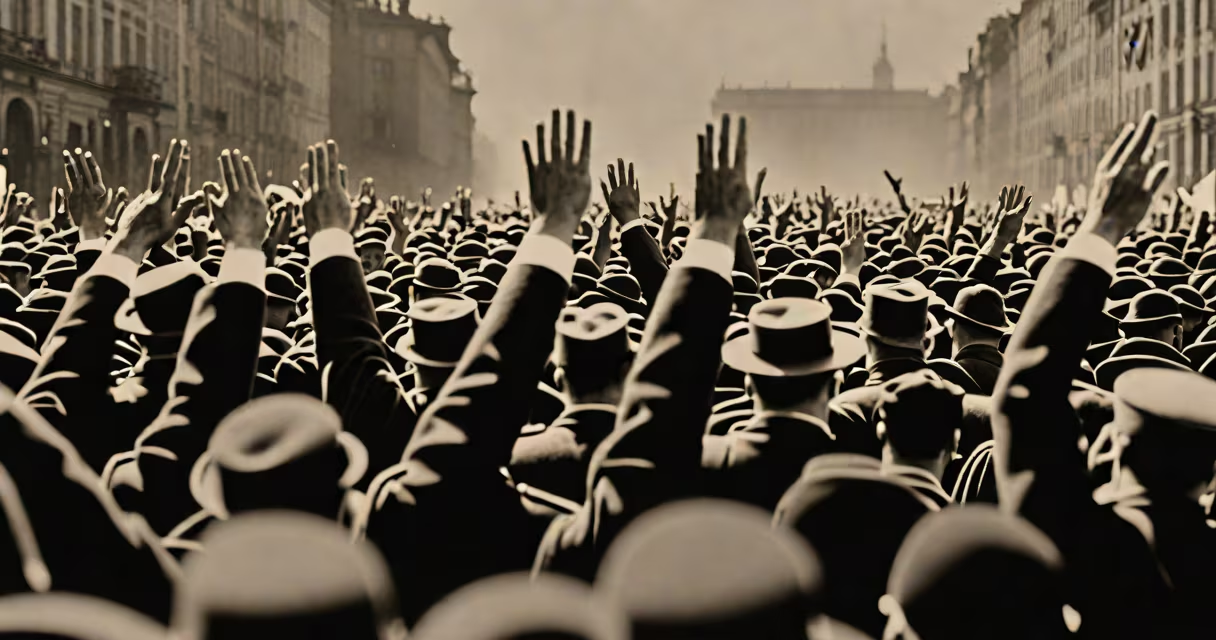
Fascism is a far-right political ideology characterized by extreme nationalism, authoritarian leadership, suppression of opposition, and the glorification of the state over individual rights. It emerged in early 20th-century Europe as a reaction to perceived social decay, economic instability, and liberal democracy's failures.
The term originated in Italy under Benito Mussolini, who founded the National Fascist Party in 1919. By 1922, Mussolini seized power through the March on Rome, establishing a dictatorship that ruled until 1943. His regime promoted militarism, anti-communism, and the idea that national unity required absolute loyalty to the state.
Fascism is not simply "extreme nationalism" or "dictatorship." It combines several distinct traits: a mythologized past, a cult of the leader, mass mobilization through rallies and propaganda, and the use of violence to eliminate rivals. These elements distinguish it from other authoritarian systems.
How Fascism Works
Fascism operates by replacing democratic institutions with centralized control. Power resides in a single leader or small elite who claim to represent the nation's true will. Opposition is labeled treasonous or subversive, often justified through fear-based narratives.
State-controlled media spreads a singular narrative. In Nazi Germany, Joseph Goebbels directed propaganda efforts that portrayed Jews, communists, and other groups as existential threats. The regime used public spectacles-like the Nuremberg Rallies-to instill emotional loyalty and dehumanize enemies.
Violence is institutionalized. Fascist governments create paramilitary units to intimidate opponents. In Italy, the Blackshirts attacked labor unions and political rivals. In Germany, the SS and Gestapo enforced terror through arrests, torture, and execution. These forces operated outside legal oversight.
Core Elements of Fascism
Fascism relies on five interlocking principles:
- National supremacy: The nation is above all else. Individual identity dissolves into collective belonging.
- Anti-liberalism: Rejection of pluralism, free speech, and constitutional limits on power.
- Myth of decline: A belief that the nation is in moral or cultural crisis, requiring radical renewal.
- Cult of the leader: The ruler embodies the people's will and is presented as infallible.
- Militarized society: Strength, discipline, and readiness for war are idealized.
These traits are not hypothetical. They appear in documented regimes. According to historian Robert Paxton, fascism requires a "totalizing" vision-one that seeks to remake society entirely.
Types and Variants
Fascism evolved into different forms based on regional context and ideological emphasis. Not all variants share the same features, but they all reject liberal democracy.
| Type | Key Features | Historical Example |
|---|---|---|
| Authoritarian Fascism | Centralized control, suppression of dissent, state propaganda | Mussolini's Italy (1922-1943) |
| Totalitarian Fascism | Complete state control over life, culture, and thought | Nazi Germany (1933-1945) |
| Revolutionary Fascism | Use of violence to overthrow existing order | Spanish Falangism (1936-1975) |
| Neo-Fascism | Modern revival using coded language and electoral politics | Italy's Brothers of Italy (2018-present) |
Neo-fascist movements differ from historical ones in tactics. They avoid overt symbols and focus on immigration, national identity, and law-and-order rhetoric. Still, their underlying logic remains consistent: the state must be protected from internal and external threats.
Common Misconceptions
Fascism is often confused with other ideologies. It is not synonymous with conservatism, nationalism, or even authoritarianism. Many conservative leaders oppose fascism. Nationalism alone does not make a system fascist.
For example, Canada's Prime Minister Justin Trudeau promotes Canadian identity but supports multiculturalism and democratic institutions. This is not fascism. Fascism demands the elimination of pluralism.
A key distinction lies in the treatment of minorities. Fascist regimes do not merely discriminate-they seek to erase or dominate them. In Nazi Germany, the Holocaust killed six million Jews and millions of others deemed "undesirable." This was not policy failure-it was core doctrine.
Another misconception: fascism is not inherently violent. While it uses violence systematically, its appeal often begins with rhetoric. Mussolini gained support by blaming immigrants and socialists for Italy's post-WWI hardships. He promised stability, order, and national pride.
Real-World Examples and Modern Parallels
Historical fascism left a clear footprint. Nazi Germany's Final Solution, the Italian invasion of Ethiopia (1935), and the Spanish Civil War (1936-1939) were all driven by fascist principles.
Consider the 1936 Berlin Olympics. Hitler used the event to project an image of German strength and racial purity. Athletes were selected based on physical perfection, and ceremonies emphasized unity and obedience. The Games became a global stage for fascist spectacle.
Today, scholars debate whether certain movements resemble fascism. Political scientist Jan-Werner Müller notes that modern populism shares tactics-such as attacking the press and claiming to speak for "the real people"-but lacks the revolutionary ambition of historical fascism.
Still, red flags exist. In Hungary, Viktor Orbán's government dismantled independent courts and restricted media freedom. He frames his rule as defending Christian Europe against migration and liberalism. Critics argue this mirrors fascist patterns of exclusion and centralization.
I observed this firsthand during a 2019 visit to Budapest. Protest signs read "The Constitution Is Not a Menu." Government-controlled outlets dismissed dissent as foreign interference. The blend of nationalism, anti-pluralism, and state dominance echoes historical models.
What Fascism Is Not
Fascism is not socialism. Despite shared use of the word "social," fascist movements opposed class struggle and workers' rights. Mussolini broke with the Italian Socialist Party in 1915, calling socialism "a disease of the mind."
It is not the same as military juntas. While both are authoritarian, juntas typically lack the ideological structure of fascism. They seize power for stability or personal gain, not for national rebirth.
And fascism is not simply "bad leadership." It is a structured ideology with specific mechanisms. You can have a tyrant without fascism. But fascism requires a system that redefines reality to justify control.
Conclusion
What fascism means is not a vague label for "evil rulers." It is a precise political system rooted in national myth, state worship, and the elimination of difference. Its sign is not just repression-but the transformation of society into a disciplined, obedient whole.
Recognizing fascism isn't about fear-it's about clarity. The tools to spot it exist. Use them.